Address
Arusha Njiro
Work Hours
80 Hours A week
Address
Arusha Njiro
Work Hours
80 Hours A week

 ByIziraa
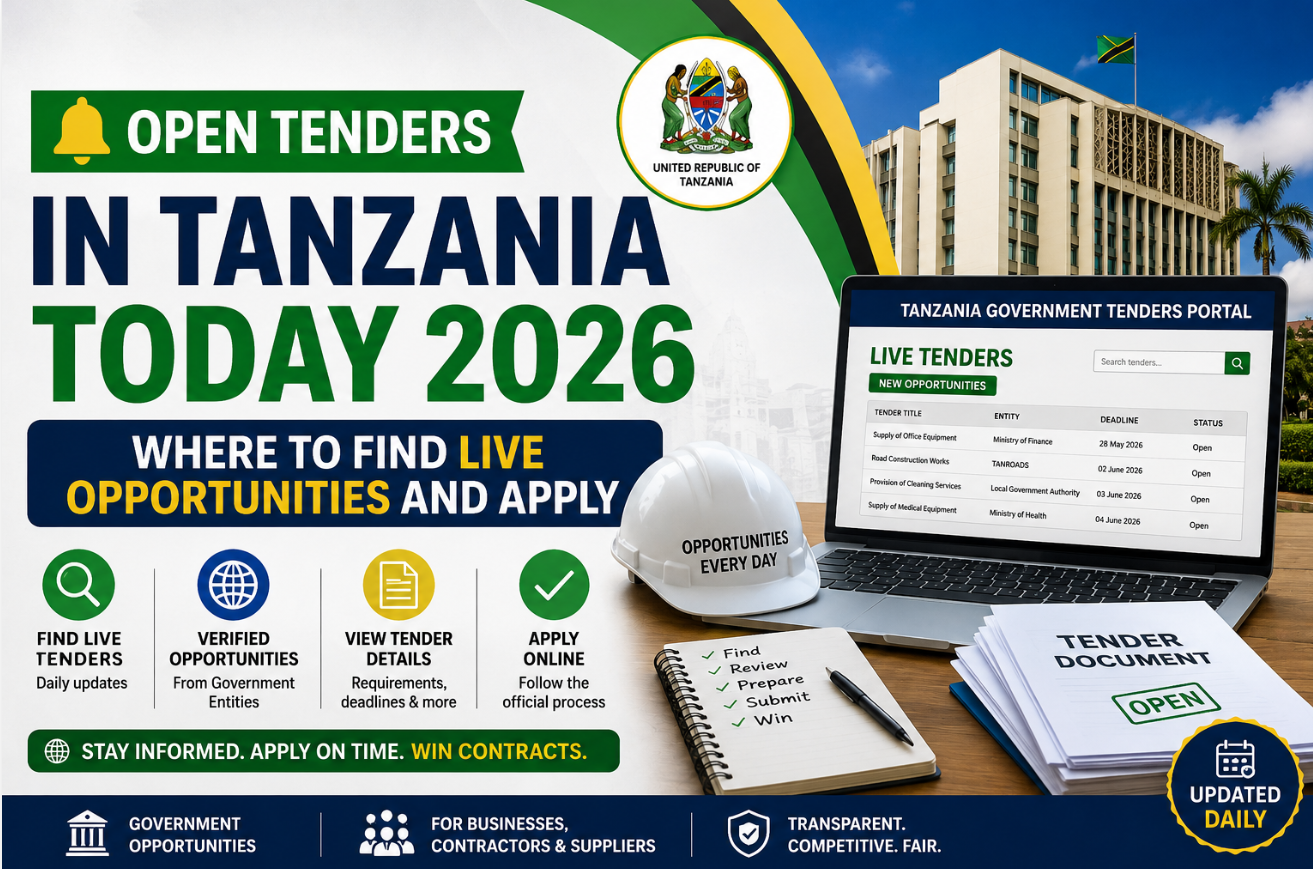
If you are searching for open tenders in Tanzania today 2026, the most important place to start is Tanzania’s official National e-Procurement System (NeST) rather than relying on WhatsApp groups, copied tender PDFs or third-party websites.
As of 20 August 2026, NeST’s published-tenders page is actively listing public procurement opportunities with invitation dates, submission deadlines and procuring entities. For example, the live page recently displayed a tender from Kigoma Urban Water Supply and Sanitation Authority, invited on 19 August 2026 with a submission deadline of 27 August 2026 at 2:00 PM. Because the list changes continuously, businesses should treat NeST itself as the live source rather than depending on a static article.
Check open tenders in Tanzania on NeST
That is the central message of this guide:
Do not search only for tender documents. Build a system for finding open opportunities every day before competitors do.
Government ministries, agencies, local authorities, public universities, hospitals, utilities and other procuring entities purchase goods, works, consultancy services and operational services throughout the financial year.
A business supplying computers, furniture, cleaning, training, security, construction, transport, printing, agricultural inputs, professional consultancy or maintenance may therefore find opportunities within the public procurement system.
This guide shows you how to find open tenders in Tanzania today 2026, search them intelligently, monitor future procurement opportunities and decide which tenders are worth pursuing.
| What you need | Best official source |
|---|---|
| Open public tenders today | NeST Published Tenders |
| 2026/2027 procurement plans | NeST Annual Procurement Plans |
| Procuring entities | NeST Procuring Entity Directory |
| Procurement regulations | PPRA |
| Recent procurement notices | PPRA Announcements |
| Circulars | PPRA Circulars |
| Award and contract data | NeST Open Contracting Data Portal |
| Contractor verification | Contractors Registration Board |
| Tenderer registration | NeST |
Useful starting points:
The first place should be NeST.
PPRA describes NeST as Tanzania’s electronic procurement system supporting functions including e-registration, e-tendering, electronic contract management and other procurement processes.
The published-tenders section is specifically designed to display opportunities issued by government procuring entities. The live page continues to publish active invitations with current submission deadlines.
Instead of searching Google every morning for:
Tanzania tenders today
go directly to the original system.
Then search by:
This reduces the risk of finding expired or copied information.
A tender opportunity has a limited life.
The process may look like:
Publication → clarification period → bid preparation → submission deadline → evaluation → award
A tender that was open two weeks ago may be closed today.
This is why articles listing “20 current tenders” can become outdated quickly.
The best tender website is therefore not necessarily the website with the longest list.
The best source is the one connected to the current procurement process.
For public procurement in Tanzania, that means checking NeST regularly.
When checked on 20 August 2026, NeST’s current published-tender page included a tender from Kigoma Urban Water Supply and Sanitation Authority, showing:
That example proves why suppliers should monitor the official system frequently: opportunities can appear only days before you discover them.
However, do not treat this one example as a complete list of all tenders open today.
Use:
for the live and changing list.
The biggest mistake is typing only:
tender
That keyword is too broad.
Instead, search according to what you sell.
Try:
Try:
Search:
Search:
Use:
Try:
The closer the search keyword is to your actual business, the more useful the results become.
Government procurement opportunities can come from:
The NeST system publishes opportunities from multiple procuring entities rather than one institution alone.
Businesses should therefore avoid monitoring only one ministry or agency.
Instead, build a list of buyers relevant to your sector.
Construction is one of the most searched procurement categories.
Typical opportunities can involve:
Before bidding, contractors should check whether the tender requires a specific registration class or professional qualification.
Do not bid merely because your company performs “construction.”
Check whether your registration matches the actual scope.
Contractor information can be verified through the Contractors Registration Board.
Public institutions need recurring supplies.
Possible procurement categories include:
This is especially important for SMEs.
Many smaller companies wrongly assume government procurement means only billion-shilling road projects.
Public entities also purchase ordinary operational items.
End Consultancy services may include:
Consultancy bids may be evaluated differently from ordinary goods tenders.
The procuring entity may pay close attention to:
Consultants should therefore maintain updated CVs and evidence of completed assignments.
Businesses providing operational services can search for:
These opportunities may provide easier entry for smaller firms than large infrastructure projects.
However, eligibility requirements still matter.
Small and medium-sized businesses should not attempt to bid for everything.
Choose a niche.
Weak positioning:
We supply everything.
Stronger positioning:
We supply office furniture and workstation equipment to institutions in Tanzania.
Or:
We provide commercial cleaning and fumigation services for offices, hospitals and educational institutions.
Or:
We provide printing, branding and conference-material production.
Specialisation helps you understand:
It also makes your company profile more credible.
Public procurement in Tanzania includes preference arrangements for recognised special groups.
PPRA’s June 2026 procurement announcements included guidance on the allocation of 30% of an institution’s annual procurement plan for special groups.
PPRA’s sustainability guidance also states that its procurement approach supports SMEs and participation by groups including youth, women, older persons and persons with disabilities.
Eligible groups should therefore avoid assuming that government procurement is automatically inaccessible to smaller enterprises.
The key is to understand:
Businesses that search only open tenders are already late compared with competitors studying procurement plans.
NeST currently publishes annual procurement plans for the 2026/2027 financial year.
These plans can provide advance intelligence about what institutions intend to purchase.
Search 2026/2027 Annual Procurement Plans
A procurement plan may help answer:
This gives suppliers time to prepare.
Create a spreadsheet.
Use columns such as:
| Procuring entity | Planned procurement | Expected timing | Category | Preparation |
|---|---|---|---|---|
| Institution A | Office furniture | Q2 | Goods | Update supplier quotations |
| Institution B | Training services | Q3 | Services | Prepare trainer CVs |
| Institution C | Building works | Q1 | Works | Confirm CRB documentation |
| Institution D | Computers | Q2 | Goods | Obtain manufacturer quotations |
Then update the spreadsheet every week.
This transforms tender searching into business development.
PPRA remains another important source because procurement rules and system guidance can change.
Recent PPRA announcements in 2026 include:
Suppliers should monitor regulatory updates rather than relying permanently on tender procedures learned several years ago.
One of the smartest procurement strategies is studying what has already been purchased.
PPRA’s NeST Open Contracting Data Portal provides procurement information covering stages including procurement planning, tendering and contract awards. Users can filter data by fields such as procuring entity, procurement method, tender status, financial year, geography and contract value.
Historical information can help answer:
Do not assume that future prices or specifications will be identical.
Use previous awards for market intelligence, not as a replacement for the new tender document.
A serious supplier can spend 15–30 minutes daily monitoring opportunities.
Check:
Review:
Update:
This reduces last-minute tender preparation.
Your tracker might contain:
| Column | Why it matters |
|---|---|
| Tender number | Identification |
| Procuring entity | Buyer |
| Description | Opportunity |
| Category | Goods, works or service |
| Publication date | Monitoring |
| Closing date | Deadline |
| Eligibility | Go/no-go decision |
| Bid security | Compliance |
| Responsible person | Accountability |
| Status | Reviewing/submitted/won/lost |
| Result | Learning |
After several months, this becomes valuable internal data.
Do not submit every tender you find.
Before bidding, ask:
Do you actually provide the required product or service?
Check licences, registrations and experience.
A government contract may require working capital before payment.
Tender preparation can involve multiple documents.
Winning revenue does not automatically mean winning profit.
Consider your price, experience, technical capability and location.
If several answers are weak, concentrate resources elsewhere.
Maintain a digital tender folder containing documents relevant to your business.
These may include:
Not every tender requires every document.
Always follow the specific tender requirements.
Businesses can lose opportunities through avoidable errors.
One missing mandatory requirement can damage the entire bid.
Copying material from an old bid creates dangerous errors.
Check names, addresses and registration details.
Never wait for the final minutes.
Possible problems include:
Tender conditions can be amended.
Continue monitoring the procurement after deciding to participate.
A WhatsApp screenshot may help alert you to an opportunity.
It should not be your final evidence.
Verify:
through NeST or the procuring entity.
Scammers know businesses are eager to win contracts.
Be suspicious when someone:
PPRA’s 2026 public notices have continued to include debarment actions involving issues such as forgery, false representation and failure to implement procurement contracts, highlighting the importance of integrity and compliance.
Never falsify:
Businesses and professionals exploring procurement opportunities can also use:
Historical Iziraa vacancy pages should be clearly treated as archival unless the particular opportunity has been freshly verified.
Keep these available:
These sources are more reliable than unofficial tender reposting websites.
Start with the official NeST published-tenders page. It displays public procurement opportunities issued by Tanzanian procuring entities.
Yes. When checked on 20 August 2026, NeST was displaying current opportunities, including a tender invited on 19 August with a deadline later in August. The list changes continuously.
Yes. PPRA identifies NeST as Tanzania’s National e-Procurement System used for electronic public procurement activities.
Check NeST’s annual procurement plans. The platform currently lists procurement plans for the 2026/2027 financial year.
Yes, provided they satisfy the tender’s eligibility and qualification requirements.
Tanzania’s procurement framework includes arrangements relating to special groups. PPRA issued 2026 guidance concerning allocation of 30% of annual procurement plans for special groups.
Use WhatsApp only as an alert. Verify the tender through NeST before acting.
Businesses that depend heavily on public contracts should check daily or several times each week.
No. Concentrate on opportunities where you meet the qualifications and can deliver profitably.
Use the NeST Open Contracting Data Portal. It publishes procurement data covering planning, tendering and award stages.
Before bidding:
The most reliable way to find open tenders in Tanzania today 2026 is to monitor NeST directly.
Do not depend on static lists because public procurement opportunities open and close continuously.
Check active tenders, but go further.
Study the 2026/2027 procurement plans. Follow PPRA notices. Research previous awards through the NeST Data Portal. Build a tender tracker and monitor keywords related to your business.
A supplier searching once per month reacts to opportunities.
A supplier monitoring procurement every day builds a pipeline.
That difference matters.
Whether you sell office furniture, ICT equipment, consultancy, construction, cleaning, training, transport or professional services, identify the public institutions that buy what you provide and prepare before the tender appears.