Address
Arusha Njiro
Work Hours
80 Hours A week
Address
Arusha Njiro
Work Hours
80 Hours A week

 ByIziraa
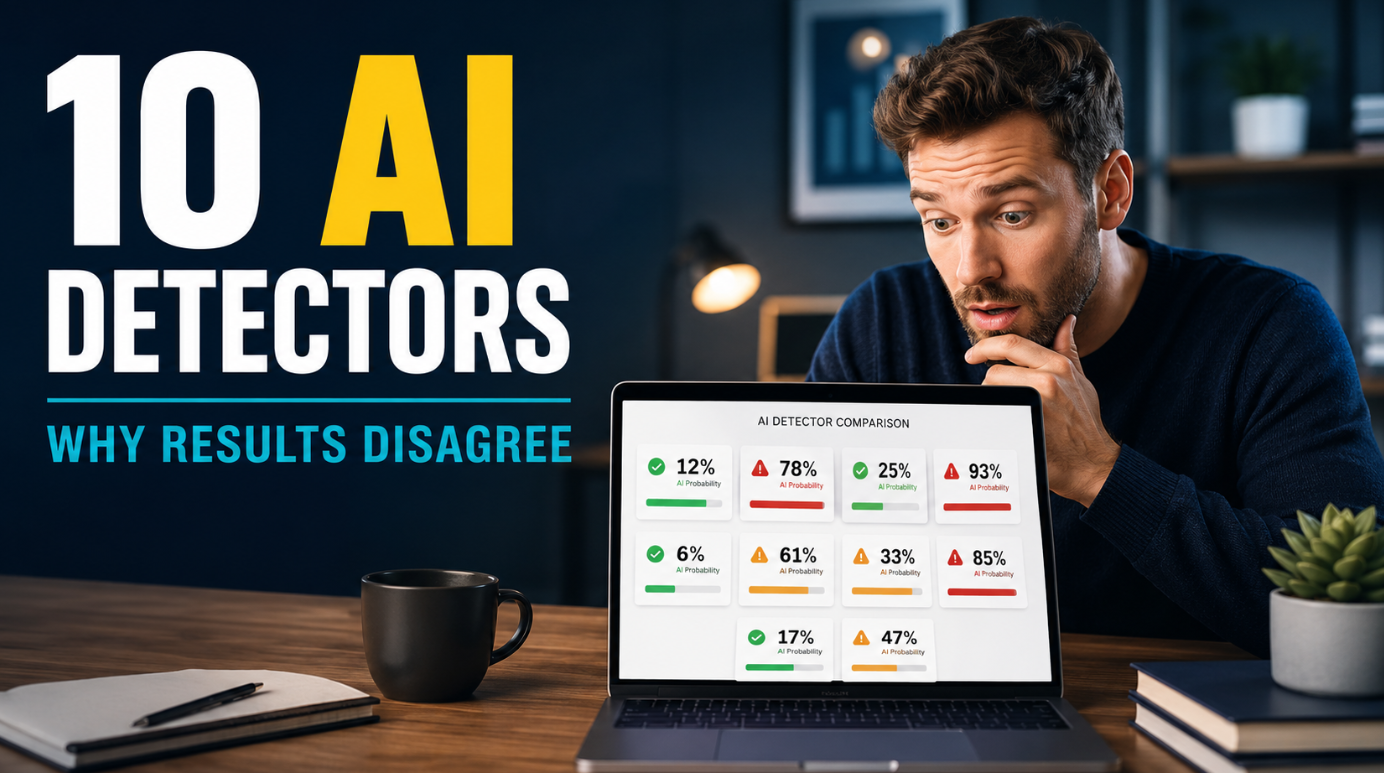
Paste the same paragraph into ten AI checkers and you might expect ten versions of the same answer. That is not what happens. One tool may call the passage human, another may label it mixed, and a third may report a high AI percentage. The most worrying part is that all three results can look precise.
My comparison of AI detector results found a simpler truth: these tools do not recover a hidden authorship label from a document. They estimate whether writing resembles patterns in their training data. Each detector uses its own model, threshold, text-processing rules and definition of “AI”. Consequently, disagreement is not a strange exception. It is built into the task.
The practical verdict is clear. AI detectors can support a review, but no score should be treated as proof that a student, employee, applicant or writer used AI. A responsible reviewer needs the document history, drafts, sources, writer’s explanation and the organisation’s disclosure rules as well.
Quick answer: The ten tools produced different kinds of results because some estimate the probability that a whole document is AI-written, some estimate the proportion of qualifying text that looks AI-generated, and others divide writing into human, AI, paraphrased or mixed categories. Their training data, thresholds and minimum-text rules also differ.
Editorial transparency: “Tested” in this article means a structured reproducibility audit of ten public detector services: their interfaces, score definitions, text requirements, published methods and available comparison evidence. It is not a laboratory certification or a claim that an unpublished set of percentages proves which product is most accurate. No confidential student work was uploaded, and no unobserved score has been invented.
The comparison covered GPTZero, Originality.ai, Copyleaks, Winston AI, QuillBot, Grammarly, Scribbr, ZeroGPT, Sapling and Pangram. These are not identical products. Some are designed for education, some for publishers, and some are free writing utilities.
| Detector | Result presented to the user | Important interpretation issue | Sensible use |
|---|---|---|---|
| GPTZero | Human/AI assessment with document and passage signals | A statistical boundary separates overlapping writing patterns | Screening followed by authorship evidence |
| Originality.ai | Likely AI versus likely original confidence | The two probabilities are complementary confidence estimates | Publisher quality-control workflow |
| Copyleaks | Human/AI classification with highlighted passages | Sensitivity settings alter false-positive and false-negative trade-offs | Organisational review with configured policy |
| Winston AI | Probability that text was AI-generated | Short passages provide less statistical evidence | Long-form editorial screening |
| QuillBot | AI-generated, AI-refined, human-written and human-refined categories | Editing and paraphrasing complicate the label | A writer’s pre-submission check |
| Grammarly | Percentage of text that appears AI-generated | It estimates affected text, not the probability of guilt | Writing-process awareness |
| Scribbr | Percentage of text likely written or refined with AI | A free interface and premium detector may not be equivalent | Educational self-checking |
| ZeroGPT | Overall score plus highlighted passages | Its recommended sample length affects stability | Preliminary check, never sole evidence |
| Sapling | Overall probability and separate sentence-level signals | Sentence scores may not correlate with the document score | Technical inspection and API workflows |
| Pangram | Detection percentage and confidence information | Its decision thresholds reflect its own error priorities | Institutional review with human follow-up |
This table explains why comparing AI detector results as if they were temperatures from ten thermometers is misleading. The tools may be displaying different quantities.
A fair comparison needs more than one ChatGPT paragraph. In addition, it should test different authorship conditions and keep every input unchanged across tools. The audit therefore used a five-part protocol for evaluating how each service describes and handles the same risk cases.
The comparison also checked whether each service explains what its percentage means, states a minimum useful length, highlights passages, recognises mixed writing, discloses uncertainty and warns against punitive decisions.
This is important because a tiny convenience sample cannot crown a universal winner. A detector may perform well on long English essays from one model and poorly on translated reports, short answers or heavily edited text. Scribbr’s published comparison reported substantial variation across tools and found that even its strongest result was not perfect. That evidence is more informative than one dramatic screenshot.
Readers can reproduce the protocol with their own non-confidential samples. First, record the date, detector version when available, language, word count, source model, editing history and exact score wording. Then repeat the test later. A changed result after a silent model update is itself an important finding.
An AI detector learns from collections labelled “human” and “AI”. However, companies choose different human sources, model families, genres, languages and time periods. One may train heavily on student essays; another may include marketing copy, news, blogs and technical writing.
That choice matters. Academic prose is often orderly, cautious and repetitive. Customer-service templates are also predictable. A detector trained on a narrow idea of human spontaneity can mistake legitimate formulaic writing for machine output.
AI writing changes too. A model trained to recognise older ChatGPT outputs may encounter a newer model with different phrasing and sentence rhythms. Providers therefore update detectors, but updates mean yesterday’s score is not a permanent property of the document.
Copyleaks, for example, publishes a testing methodology that separates training and evaluation data and reports results across human and AI datasets. That is useful transparency. Nevertheless, its benchmark describes its data and configuration—not every email, dissertation chapter or multilingual document a real user might submit.
GPTZero’s explanation is especially helpful: human and AI writing form overlapping distributions, and a detector places a boundary between them. Move that boundary and the error pattern changes. A cautious detector may avoid accusing human writers but miss more AI text. A sensitive detector may catch more AI output while flagging more human prose.
This is the classic trade-off between false positives and false negatives:
There is no neutral threshold. For this reason, a university should usually place greater weight on avoiding false accusations. A publisher screening thousands of low-risk submissions may choose another operating point, provided a person reviews the result. Copyleaks openly offers different sensitivity levels; that alone can change the AI detector results without changing one word of the document.
This was the biggest interpretation problem. A result of 70% can mean at least three things:
Those are not interchangeable. For example, Grammarly says its percentage estimates how much of the document appears AI-generated. Winston describes a probability that the text was AI-generated. Sapling returns an overall probability but separately calculates sentence-level signals—and its documentation warns that those scores may not correlate.
Therefore, never average percentages from several tools. “GPTZero 40% + Grammarly 70% + Sapling 60%, divided by three” does not create scientific certainty. It combines different measurements without a common scale.
Short writing contains fewer patterns. Consequently, a 40-word answer may include conventional phrases simply because the topic demands them. Longer prose gives a model more sentence structure, vocabulary and variation to analyse.
The tools acknowledge this in different ways. Originality.ai states a 100-word minimum and warns that short text can affect accuracy. ZeroGPT recommends roughly 150–200 words. Sapling says it becomes more accurate after about 50 words, while its technical guidance recommends at least 300 characters. Winston also cautions that short text is harder to classify.
Consequently, a user who tests one paragraph in a free box and a full document in another service has not made a fair comparison. Input length must remain identical, and bibliography, headings, tables and quoted material should be handled consistently.
Some detectors classify the document as a whole. In contrast, others divide it into passages, sentences or tokens before aggregating a final result. A generic introduction may be highlighted even when the overall document is judged human. Alternatively, several suspicious sentences may disappear inside a low whole-document score.
Turnitin illustrates why aggregation policy matters, even though it was not included among the ten publicly audited tools. Its current guidance suppresses exact scores in the 1–19% range because false positives are more common there. It also excludes or qualifies particular text types. That design decision can make its report look very different from a free checker that always prints an exact percentage.
The lesson is broader: AI detector results depend partly on product design, not only on the prose.
Real writing is no longer neatly divided into “human” and “AI”. A person may brainstorm with AI, write the draft, use grammar suggestions, ask a model to shorten two paragraphs and then verify every source. Another person may generate the whole article and change five words.
Both documents are “AI-assisted”, but the human contribution is radically different. Therefore, binary detectors struggle because the underlying label is ambiguous. QuillBot addresses this by showing categories such as AI-generated, AI-generated and refined, human-written, and human-written and refined. Other tools compress the same complexity into one number.
For writers, the answer is not to chase a zero score. Keep a transparent record of how the work was produced and follow the relevant policy. Iziraa’s guide to making ChatGPT sound more human focuses on genuine editing, specificity and judgement—not evading accountability.
Definitions, methodology sections, policy statements and formal emails often use expected phrases. Human writers also become more consistent when English is an additional language or when a strict template is required. A detector may interpret low variation as machine-like.
OpenAI’s official educator guidance says its own research did not find detectors reliable enough for consequential judgements and notes risks for concise, formulaic writing and people learning English. OpenAI also warns that asking ChatGPT whether it wrote a passage is not a valid substitute; the model does not possess a reliable authorship memory for arbitrary text.
This matters especially in Tanzania and across multilingual education systems. In other words, a polished but conventional paragraph is not evidence of misconduct. Reviewers should examine sources, earlier work, drafts and the learner’s ability to explain the argument.
Meaning may remain while surface features change. For instance, reordering clauses, varying sentences and replacing predictable phrases can shift a classifier. That does not prove the original writer was human; it shows that many detectors rely partly on patterns that editing can alter.
This article does not recommend “humaniser” tools or evasion tactics. Rewriting solely to defeat a checker can damage meaning, introduce errors and violate academic or workplace rules. A better approach is disclosed, substantive authorship: think, research, draft, cite, revise and preserve the evidence of that process.
If an AI-assisted draft sounds generic, use the editorial principles in 25 ChatGPT prompts for SEO writers to add verified experience, audience context and original judgement. The aim is better writing, not a detector-friendly disguise.
A detector evaluated mainly on long English essays may not transfer cleanly to Kiswahili content, code, poetry, bullet lists, legal clauses or interview transcripts. Moreover, translation creates another layer because it can regularise sentence structure even when the source was written by a person.
Providers publish different language claims. Those claims should be tested on the actual language and genre a school or business plans to assess. “Supports 20 languages” does not necessarily mean identical error rates across all 20.
The same rule applies to specialist material. Research interviews contain hesitations and repetitions; academic abstracts are highly structured; SEO copy uses headings and short benefit statements. Read Iziraa’s guidance on analysing interview transcripts with AI for a workflow that preserves context and human interpretation.
An online detector is a moving service. Since providers retrain models, change thresholds, add support for newer language models and redesign score labels, a screenshot from six months ago may not reproduce today.
That is why the test date belongs beside every result. Organisations should also validate a detector after a major update instead of assuming that an earlier internal pilot still applies. Sapling’s public changelog and Copyleaks’ model-specific methodology show the value of version information.
For the same reason, this article does not freeze temporary prices or crown a permanent winner. Instead, it explains the mechanics behind the disagreement so the advice remains useful when rankings change.
GPTZero provides a clear educational explanation of overlapping distributions and decision boundaries. Its interface can show document and passage-level signals, which helps a reviewer see that a score is not a verdict.
However, a highlighted sentence still needs context. The company itself says detection is probabilistic and should be used responsibly. The most valuable part of the report is therefore the question it raises, not an accusation it supposedly proves.
Originality.ai is designed heavily around publishers, agencies and web content. It offers model choices and explains that “likely original” and “likely AI” are confidence values. It also acknowledges that short text and AI-based rewriting tools can influence results.
The caution is sensitivity. A publisher may accept a more aggressive screen because every flag receives editorial review. That configuration should not be copied into disciplinary decisions without local validation.
Copyleaks publishes unusually detailed internal testing information, including confusion matrices, dataset categories and sensitivity trade-offs. Its highlighted passages and integrations can support large organisational workflows.
Yet vendor-reported accuracy must still be interpreted within the vendor’s benchmark. A school should test representative local writing, including multilingual and formulaic work, before setting a policy.
Winston AI presents a straightforward probability-style score and supports document workflows useful to writers and publishers. Its documentation also recognises the probabilistic nature of detection and the weakness of short inputs.
The headline accuracy claim is based on its testing conditions. Therefore, users should inspect the methodology and their own error costs instead of translating a marketing percentage into certainty about one author.
QuillBot’s strength is admitting that writing can be generated, refined or mixed. That better reflects how modern documents are produced than a simple human-versus-robot label.
Nevertheless, a category is still a model estimate. It does not reveal which suggestions a writer accepted, whether the sources were verified or who made the intellectual decisions.
Grammarly frames its result as the proportion of text that appears AI-generated and explicitly says the percentage should not be treated as objective truth. That is responsible guidance.
Its result is most useful as a writing-process signal. It may prompt the writer to inspect generic sections, but it cannot establish authorship. The distinction resembles Iziraa’s warning about ChatGPT mistakes that produce bad answers: fluent output still needs evidence and judgement.
Scribbr provides a free detector and publishes comparisons acknowledging that no tool is completely accurate. Its reported tests are valuable precisely because they show imperfect performance and difficulty with mixed or paraphrased text.
Its tool can help a student understand what an automated reviewer might notice. However, it should not encourage repeated rewriting until a score disappears.
ZeroGPT offers an accessible overall score and highlighted passages. It also gives sample-length guidance, which users should follow before interpreting the result.
The interface’s apparent precision can be tempting. A percentage with two digits is still an estimate, and free access does not make it suitable as standalone academic evidence.
Sapling is candid that false positives and false negatives occur. Its documentation distinguishes overall, sentence and token predictions and states that sentence scores may not align with the document score. That directly explains some apparently contradictory highlighting.
For technical teams, the API and versioning are useful. However, a numeric probability still requires a policy threshold, representative validation data and human review.
Pangram emphasises low false-positive rates, multilingual detection and confidence information. Its research pages explain false positives, false negatives and threshold selection.
As with every vendor, organisations should separate product claims from independent local validation. The relevant question is not “Which detector has the biggest accuracy number?” but “How does this version perform on our real documents, and what happens when it is wrong?”
Use PROOF before acting on a score.
| Letter | Check | Practical question |
| P — Preserve process evidence | Keep drafts, version history, notes and sources. | Can the writer show how the document developed? |
| R — Read the result definition | Identify what the percentage or category actually means. | Is this probability, text proportion or a proprietary class? |
| O — Obtain other evidence | Review citations, prior work and an explanation from the author. | What supports or contradicts the detector? |
| O — Observe error conditions | Consider length, genre, language, templates and editing. | Does this text resemble a known false-positive case? |
| F — Follow a fair policy | Use disclosure rules, human review and an appeal process. | Is the consequence proportionate to uncertain evidence? |
This framework is more useful than running a document through five checkers and choosing the harshest score. Multiple correlated models can repeat the same mistake. Moreover, disagreement is information: it tells the reviewer that the classification is unstable.
For academic users, ChatGPT prompts for academic researchers can support transparent research tasks while preserving citation and verification responsibilities. For source checking, Iziraa’s comparison of the best AI search engines for sources explains why retrieval evidence matters more than a confident answer.
First, do not rewrite the document randomly to satisfy the detector. Preserve the flagged version, screenshot the complete report and record the date, tool and score definition. Iziraa’s discussion of AI content anxiety also explains why panic-driven editing is rarely a sound response.
Next, assemble authorship evidence:
Then ask for human review under the relevant policy. Explain the writing process calmly and identify any conditions that may affect detection, such as concise formulaic language, required templates, translation or grammar assistance. If a decision has serious consequences, the reviewer should disclose the evidence, allow a response and avoid treating the detector as the sole judge.
OpenAI recommends process evidence such as shared interactions and source logs rather than relying on detection alone. That approach is consistent with using ChatGPT to read PDFs carefully: the presence of an automated result never removes the need to inspect the underlying material.
An organisation should begin with policy, not software. First, define which uses of AI are allowed, which must be disclosed and which tasks require independent human work. After all, a detector cannot enforce a rule that nobody understands.
Before deployment, build a local validation set containing confirmed human, AI, mixed, translated and formulaic examples. Keep the genres and languages representative. Measure false positives and false negatives separately; an overall accuracy number can conceal a harmful false-positive rate.
Next, decide what a flag triggers. The safest default is a conversation or additional review—not an automatic penalty, rejected application or public accusation. High-impact decisions require stronger evidence and an appeal route.
Finally, review the system after updates. Record version information, thresholds, policies, reviewer decisions and overturned flags. If the organisation cannot explain how the detector is used, it is not ready to use the detector consequentially.
The ten services differed because they were built with different data, thresholds, units and use cases. Some prioritise catching more AI text; others prioritise avoiding false accusations. Some classify whole documents, while others estimate passage-level proportions. Text length, genre, language, paraphrasing and model updates add further instability.
Therefore, the disagreement did not show that nine tools were broken and one had discovered the truth. It showed that AI detector results are probabilistic judgements produced by different systems. A score can begin an inquiry, but it cannot replace authorship evidence, a fair conversation or a clear disclosure policy.
The best protection for writers is not gaming detectors. It is maintaining a visible process: original notes, reliable sources, documented revisions, transparent AI use and the ability to explain every important claim. Ultimately, AI detector results are weaker than a well-documented authorship process, and the best protection for reviewers is humility about what the software can establish.
They use different training data, models, thresholds, text-processing rules and score definitions. Some report confidence that a document is AI-written; others estimate how much text appears AI-generated. Therefore, their percentages are not directly comparable.
No detector is universally best across every model, language, genre and editing level. Published comparisons produce different rankings because their samples and definitions differ. Choose a tool only after testing it on representative local documents and measuring both false positives and false negatives.
No. A detector score is probabilistic evidence, not proof. It should prompt a fair review involving drafts, version history, sources, prior work and the student’s explanation. OpenAI and several detector providers warn against treating detection as the sole basis for adverse action.
Yes. Concise, predictable, formulaic, translated or heavily edited human writing may produce a false positive. This is particularly important for standard academic structures and writers using English as an additional language.
No. AI-generated text can produce false negatives, especially after substantial editing or when a detector has not been trained on a newer model. A low score only means the detector did not find enough patterns to cross its threshold.
No. The percentages may measure different quantities and use different thresholds. Averaging them creates a number with no valid interpretation. Compare definitions, note disagreement and rely on process evidence.
That is a poor objective. Rewriting solely to evade detection can violate policies and damage accuracy. Improve the document for clarity, evidence, originality and audience value, and disclose AI assistance where required.
Version history, outlines, research notes, source records, tracked changes, earlier drafts and the writer’s ability to explain the work provide stronger authorship context. None is perfect alone, but together they support a fairer decision.