Address
Arusha Njiro
Work Hours
80 Hours A week
Address
Arusha Njiro
Work Hours
80 Hours A week

 ByIziraa
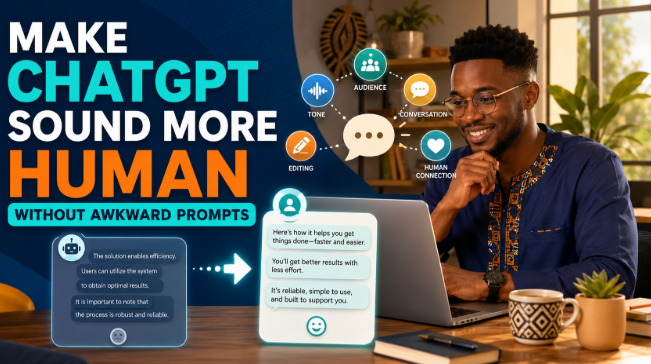
To make ChatGPT sound more human, tell it who will read the text, why you are writing, how the message should feel and what must remain true. Then review the first draft and request one or two precise changes. You do not need a huge prompt, a list of banned words or commands such as “bypass AI detection.”
A useful request can be as simple as this:
Rewrite this for a busy colleague. Keep it friendly, direct and under 120 words. Use ordinary language, preserve every fact, and end with one clear next step: [paste draft].
That prompt works because it gives ChatGPT a real communication situation. It defines the reader, tone, length and purpose. More importantly, it leaves room for you to review the result and add your own judgement.
This guide explains why some AI writing feels stiff, how to improve it with normal language and which prompt patterns work for emails, blog posts, reports, customer messages and academic explanations. It also shows what not to do. Natural writing should help readers understand you; it should not be used to misrepresent authorship or evade academic and workplace rules.
Making ChatGPT sound more human should mean making its writing clearer, more natural and better suited to a real reader. It does not mean pretending that ChatGPT is a person. Nor does it mean adding deliberate spelling errors, fake personal experiences or invented emotions.
Human communication changes with context. A message to a close colleague sounds different from a letter to a regulator. A blog introduction sounds different from a research-methodology paragraph. Therefore, “human” is not one universal tone. It is the right voice for the audience and moment.
Natural writing often has five qualities:
| Quality | What it means | Practical instruction |
|---|---|---|
| Clear | The main point appears early | “Lead with the decision.” |
| Contextual | The wording suits the reader | “Write for a first-time customer.” |
| Specific | It uses real details instead of filler | “Use the supplied delivery date and product name.” |
| Varied | Sentences do not all follow one pattern | “Mix short and medium sentences naturally.” |
| Purposeful | Every paragraph helps the reader act or understand | “End with one clear next step.” |
If you are completely new to prompting, begin with Iziraa’s guide on how to use ChatGPT for beginners. It introduces practical tasks before you start refining style.
ChatGPT often sounds generic when the request is generic. “Write a professional email” gives the model almost no information about the reader, situation, relationship or desired result. The response may therefore rely on safe, broadly applicable patterns.
Several prompt problems commonly produce stiff writing.
The same idea must be explained differently to a customer, lecturer, manager or twelve-year-old learner. Without an audience, ChatGPT has to guess the appropriate vocabulary and level of detail.
Instead of:
Explain cloud storage.
Try:
Explain cloud storage to a small-business owner who uses a smartphone but has little technical knowledge. Use one familiar example and keep it under 180 words.
“Professional” can mean formal, diplomatic, concise, confident or technical. Add one or two qualities that clarify the feeling you want.
For example:
Use a professional, calm and plain-spoken tone. Be firm about the deadline without sounding accusatory.
A long list such as “use humour, metaphors, contractions, rhetorical questions, storytelling, emotion, slang and irregular sentences” creates competing instructions. The result can sound more theatrical than natural.
Choose only the features that serve the task. A customer apology may need warmth and accountability. A financial report may need clarity and restraint. Humour may be unsuitable for both.
Natural writing depends on concrete information. If you provide no facts, examples or observations, the model may fill space with broad statements.
Give it verified raw material:
The first response is a starting point. OpenAI’s official prompting best-practices guide recommends clear, specific requests and iterative refinement. A short follow-up such as “make the opening less formal and remove repeated ideas” is usually more effective than rebuilding the entire prompt.
The VOICE formula makes prompts specific without making them awkward.
| Letter | Element | Question |
| V | Voice | How should the writing feel? |
| O | Occasion | What situation and relationship matter? |
| I | Intended reader | Who will read or hear it? |
| C | Content and constraints | Which facts, limits and requirements apply? |
| E | Expected result | What format, length and action do you need? |
Help me [write/rewrite/explain] [task]. Use a [two or three tone words] voice. The situation is [occasion and relevant relationship]. The intended reader is [audience], who needs to [understand/decide/do something]. Use only the verified content below. Preserve [facts, names, dates, quotations or technical terms]. Keep it [length and format]. End with [desired next step]. Flag missing information instead of guessing. Content: [paste material].
You rarely need every field. For a short message, audience, purpose and tone may be enough. For a report or sensitive email, use the complete structure.
OpenAI’s guide to creating a good prompt similarly recommends identifying the task, adding relevant context, setting the preferred tone and working iteratively.
The fastest improvement is to replace “people” or “the audience” with a useful description.
Write for Tanzanian university graduates applying for their first office job. Assume they understand smartphones but may not know recruitment terminology.
The description tells ChatGPT what the reader already knows and what may require explanation. It also produces more relevant examples.
Do not ask only for a format. Explain what the text must achieve.
Weak:
Write an email about the meeting.
Better:
Draft an email that confirms Tuesday’s meeting, tells participants what to prepare and makes it easy for them to identify the required action.
Purpose helps ChatGPT decide what belongs near the beginning and what can be removed.
Tone labels work best when they are concrete and compatible. Useful combinations include:
Avoid stacking ten adjectives. Also avoid instructions that conflict, such as “extremely formal, highly casual and full of slang.”
Natural language depends on social distance. Tell ChatGPT whether you are writing to a long-term client, a new customer, a supervisor, a colleague or a public audience.
This is for a supplier we have worked with for three years. Keep the relationship constructive, but make the missing-delivery issue and requested response date unmistakable.
This single sentence often does more than a long list of stylistic rules.
If you want consistency, provide 100–300 words that you wrote yourself. Then request observable qualities rather than an exact imitation of a named public figure.
Use the sample below to identify my usual level of formality, paragraph length and vocabulary. Rewrite the new text using those general characteristics. Do not copy phrases from the sample.
Remove confidential or personal information before uploading a sample. Iziraa’s guide to ChatGPT memory and privacy explains why memory, chat history and data controls should be reviewed separately.
Some drafts sound robotic because they use inflated wording. Request plain alternatives.
Use common words where they express the meaning accurately. Replace corporate filler with direct language. Keep necessary technical terms and explain each one briefly.
For example, “We are writing to inform you that” may become “We need to let you know.” However, plain language should not remove legal, medical, academic or technical precision.
Natural paragraphs usually contain some sentence variation. You can request it gently:
Mix short and medium-length sentences. Use short paragraphs. Do not begin several consecutive sentences in the same way.
Do not demand random sentence fragments or intentional errors. Those tricks often reduce credibility and accessibility.
Generic explanations become more natural when readers can picture the situation.
Explain cash flow using a small shop that buys stock today but receives customer payments later. Keep the numbers simple and show why profit and available cash can differ.
Examples should be relevant and labelled as illustrative when they are fictional. Students can find more learning-focused techniques in Iziraa’s guide to the best AI tools for accounting students.
Rewriting can accidentally alter meaning. Protect important content explicitly.
Preserve every name, date, amount, condition and commitment. Improve only clarity, flow and tone. List any statement that seems ambiguous.
This instruction is especially important for workplace communication. Iziraa’s collection of 25 ChatGPT prompts for work provides additional templates for emails, meetings, reports and daily planning.
It is easier to recognise your preferred voice when you can compare options.
Provide two versions: one warm and conversational, and one concise and professional. Preserve the same facts and call to action. Explain the main tone difference in one sentence.
You can then combine the strongest opening, explanation and ending. This is often faster than asking ChatGPT to guess your exact preference immediately.
After reading the draft, describe the specific problem:
Treat the exchange like an editing conversation. If responses fail or the interface behaves unexpectedly, use Iziraa’s ChatGPT troubleshooting guide before assuming the prompt is the problem.
Draft a short email to a colleague I work with regularly. I need the revised budget by 3:00 p.m. Thursday so I can complete Friday’s report. Use a friendly, direct tone. Do not sound angry or overly formal. Begin with the request, explain the reason in one sentence and end by asking them to confirm. Keep it under 100 words.
Write a 120-word introduction for a beginner blog post about protecting phone data. The audience is African smartphone users who want practical advice, not technical theory. Begin with the main answer, use a familiar everyday situation and preview the three actions the article explains. Keep the tone reassuring and direct. Do not use fear, invented statistics or phrases such as “in today’s digital landscape.”
Rewrite this customer reply in a calm, helpful voice. Acknowledge the inconvenience without admitting facts we have not verified. Explain the next step and genuine response time clearly. Use short paragraphs, no jargon and no more than 130 words. Preserve the order number and date exactly: [draft].
Turn the announcement below into a LinkedIn post for small-business owners. Use a confident but not boastful tone. Lead with the practical benefit, include one specific example and finish with a genuine question. Keep it between 100 and 150 words. Use no more than three relevant hashtags and do not invent results: [announcement].
Edit this report paragraph for senior managers. Keep the tone professional and measured. Lead with the finding, follow with the evidence, and end with its operational implication. Preserve all numbers and caveats. Remove repetition and promotional language. If a conclusion is not supported by the evidence, flag it rather than strengthening it: [paragraph].
Explain [concept] to a reader encountering it for the first time. Use plain British English, one everyday analogy and one small worked example. Define technical terms when they first appear. Keep the explanation accurate and under 350 words. End with two questions the reader can use to check understanding.
Review my paragraph for clarity, logical flow and grammar. Do not add evidence, citations, quotations or findings. Preserve my argument and terminology. Return: (1) an edited version, (2) a short list of changes and (3) any claim that needs a source. Follow my institution’s AI-use rules. Paragraph: [paste].
Researchers should use AI as a support tool rather than a source of invented evidence. Iziraa’s ChatGPT prompts for academic researchers provide safeguards for literature, methodology and analysis tasks.
You can also develop a natural response by talking through the situation instead of writing a large prompt:
I need to explain a project delay to my manager. Ask me five short questions about the cause, impact, revised date and support needed. Then help me draft a calm two-minute update.
For hands-free use, see Iziraa’s guide on how to use ChatGPT Voice Mode.
Awkward prompt
Make this sound extremely human, undetectable, emotional, conversational and professional. Add burstiness and perplexity. Do not sound like AI.
Natural prompt
Rewrite this update for my manager. We communicate directly, so keep it calm and concise. State what is complete, explain the verified cause of delay without excuses, give the revised date and identify the decision I need. Keep it under 140 words. Draft: [paste].
The second prompt focuses on the real communication problem. It does not ask the model to perform “humanness.”
Weak prompt
Write naturally about business AI.
Better prompt
Write a 250-word section for Tanzanian shop owners deciding whether to try an AI tool. Begin with the practical answer. Explain one low-risk use, such as drafting product descriptions, and one risk, such as uploading customer data. Use plain English and a realistic shop example. Do not invent savings or results.
For a broader tool comparison, link readers to Iziraa’s guide to practical AI tools for small businesses.
Weak prompt
Explain inflation like a human.
Better prompt
Explain inflation to a secondary-school learner using the price of the same shopping basket at two different times. Use simple fictional figures, distinguish a one-item price increase from general inflation and finish with a three-sentence summary.
The improvement comes from audience, example and scope—not a special phrase.
If you repeatedly request the same style, Custom Instructions can store broad preferences. According to OpenAI’s Custom Instructions guidance, these instructions are available across ChatGPT plans and can be edited or removed.
A useful Custom Instruction might be:
Use British English. Lead with the answer. Prefer plain language, short paragraphs and descriptive headings. Use lists only when they improve scanning. Avoid exaggerated claims, generic introductions and unnecessary emojis. When rewriting, preserve facts and flag missing information instead of guessing.
Keep permanent instructions broad. Add task-specific facts, audience and format inside the current conversation.
ChatGPT also offers selectable personalities or base styles. OpenAI’s official personality guide explains that these settings affect communication style rather than changing capabilities or safety rules. A Friendly style may suit brainstorming; Efficient may suit direct technical help; Professional may suit workplace documents. Your request and context can still adjust the tone for an individual task.
Do not place private client details, passwords, examination material or sensitive personal information in Custom Instructions. Those settings are intended for preferences, not confidential records.
The instruction is subjective. Replace it with observable qualities: audience, formality, clarity, length, examples and purpose.
Large banned-word lists can make writing strained. Remove a repeated cliché when it appears, but do not build every prompt around a blacklist.
Misspellings and poor grammar do not make writing authentic. They make it harder to read and can damage credibility.
Slang varies by age, profession, country and relationship. Use it only when it genuinely fits the audience. Never ask ChatGPT to imitate a community with stereotypes.
Describe the high-level qualities you need—such as concise, observational or lightly humorous—then develop your own voice. Do not copy distinctive wording.
One well-placed question may engage a reader. A question in every paragraph becomes predictable.
Do not let ChatGPT claim that you tested a product, visited a place, interviewed someone or achieved a result when you did not. Replace false experience with verified observation, a labelled hypothetical example or a genuine quote you have permission to use.
Separate complex work into stages: outline, draft, fact-check, tone edit and final proofread. This gives you more control and makes errors easier to identify.
ChatGPT can improve a draft, but the final human review matters most.
This review makes the document genuinely yours because you make the final decisions about meaning, evidence and tone.
No prompt can reliably guarantee that text will pass an AI detector, and “humanising” text should not be used to conceal prohibited AI assistance. Detection tools can produce uncertain or incorrect classifications. At the same time, schools, universities, publishers and employers may have rules requiring original work or disclosure.
The better approach is to use ChatGPT transparently for permitted tasks such as brainstorming, outlining, explaining, language feedback or reviewing a draft. Create the core ideas and evidence yourself. Verify every claim, follow the applicable policy and acknowledge assistance when required.
Do not ask ChatGPT to invent experiences, citations or mistakes to disguise where text came from. That does not improve writing quality. It creates a trust problem.
Give ChatGPT a real audience, purpose, relationship and tone. Supply verified details, request a suitable length and revise the first draft with focused feedback. A short contextual prompt usually works better than “make this sound human.”
Use this starter:
Rewrite this for [specific audience]. The purpose is [result]. Use a [friendly/direct/calm] tone, ordinary language and short paragraphs. Preserve every fact and end with [next step]. Draft: [paste].
Adapt the fields to the task instead of searching for one universal prompt.
You may ask it to remove a cliché or repeated phrase, but a huge banned-word list is rarely useful. Focus on clarity, concrete examples and reader needs. Then edit any wording that does not sound like you.
It can identify broad characteristics from a sample, such as sentence length, formality and vocabulary. Provide only material you have the right to use, remove private information and ask it not to copy distinctive phrases. Your final editing remains essential.
No. A personality sets a broad default communication style. Your prompt supplies the specific task, audience, context and output needs. Task instructions may alter the visible personality for that response.
Contractions can make informal English sound more conversational, but they are not always appropriate. Formal reports, legal documents or academic writing may use fewer contractions. Match the occasion instead of applying a universal rule.
Use humour only when it serves the audience and topic. A light blog post may benefit from it; a complaint, safety notice or formal report may not. Specify “light, occasional humour” rather than forcing jokes into every paragraph.
It can help improve clarity and flow when your institution permits it. However, do not use it to invent evidence, citations, findings or authorship. Preserve technical meaning, verify sources and follow disclosure requirements.
Ask for the format directly: “Use three short paragraphs and no headings,” or “Use bullets only for the final checklist.” Broad prompts may encourage a generally helpful structure that is more elaborate than you need.
Not automatically. A prompt should include enough relevant context to guide the task. Short messages work for simple tasks, while high-stakes or complex work needs clearer constraints. Relevance matters more than length.
The best way to make ChatGPT sound more human is to describe a real communication situation. Name the reader, state the purpose, choose two or three tone qualities, provide verified details and define the desired result. Then edit the response as an accountable person rather than treating the first draft as finished.
Avoid awkward “humaniser” prompts, fake errors and detector-evasion claims. Natural writing does not come from pretending. It comes from specificity, appropriate tone, concrete examples and thoughtful revision.
Start with the VOICE formula on one real message today. Keep the prompt short, compare two versions and read the result aloud. You will quickly learn which instructions improve your voice—and which ones merely add clutter.