Address
Arusha Njiro
Work Hours
80 Hours A week
Address
Arusha Njiro
Work Hours
80 Hours A week

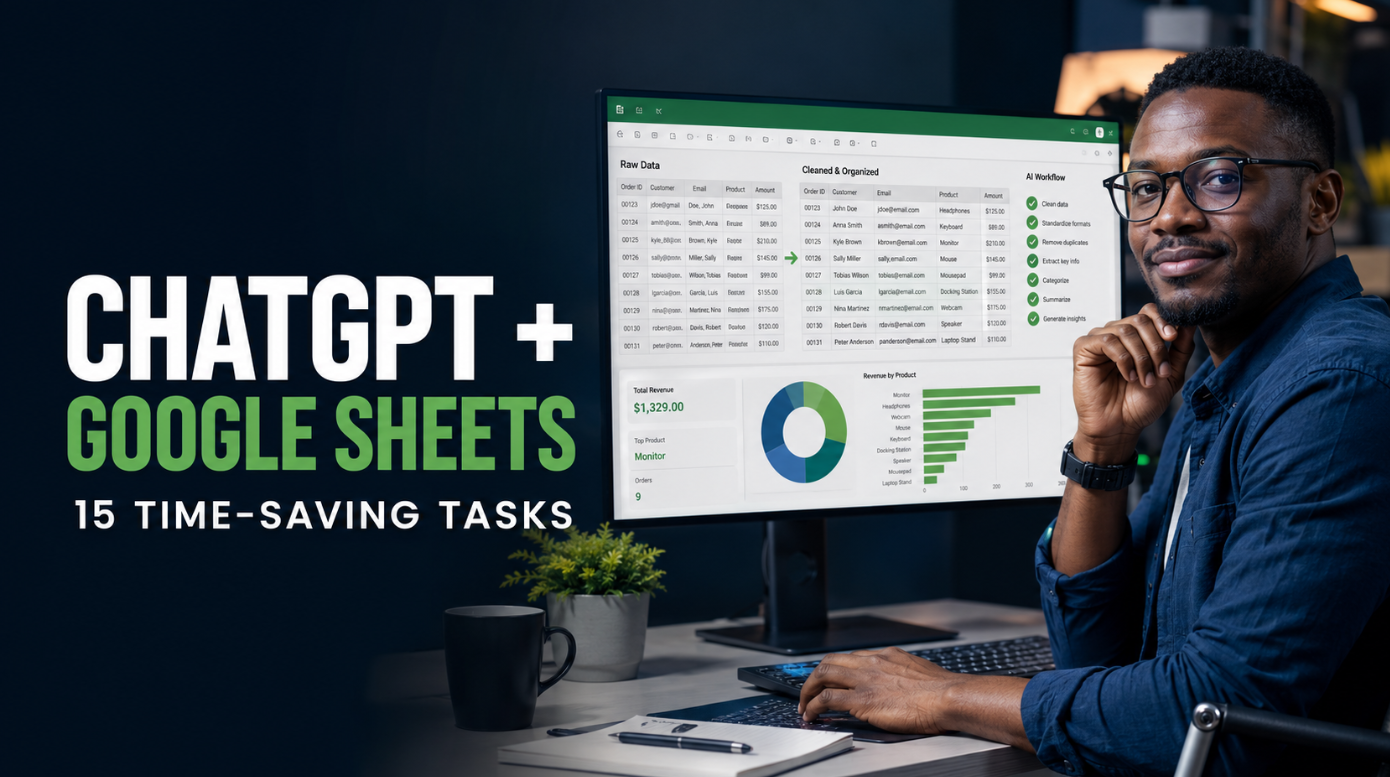
 ByIziraa
A sales officer receives hundreds of untidy records. A lecturer must categorise survey responses. An administrator spends Monday morning repairing formulas and rebuilding the same report. Google Sheets can handle these jobs, but deciding which formula, rule, chart or workflow to use often consumes more time than entering the data.
ChatGPT can shorten that thinking work. It can inspect an approved Sheet, explain formulas, propose cleaning rules, analyse patterns, design tables and create reviewable spreadsheet outputs. OpenAI’s official dataset-and-report workflow says users can attach spreadsheet files or name an approved Google Sheet through Google Drive. OpenAI has also introduced a spreadsheet experience that can analyse, update and explain work directly in supported Excel and Google Sheets environments.
However, access is only the beginning. A plausible formula can still reference the wrong column. A clean-looking category can still misclassify a record. A chart can be technically correct yet communicate the wrong message. The time saving becomes valuable only when the result is testable.
This guide uses a SHEET method: Specify the outcome, Hand over the correct range, Explain the rules, Evaluate the result and Test before replacing live data. It then demonstrates 15 tasks that save serious time, with prompts and checks you can adapt immediately.
Quick answer: To use ChatGPT with Google Sheets, open a supported in-Sheets experience, name an approved Sheet through a Google Drive connection in ChatGPT Work, or export the relevant tab as
.xlsxor.csvand upload it. Describe the sheet, relevant range, column meanings, required result and rules that must not change. Ask ChatGPT to work in a copy, explain formulas and report its checks. Verify totals, sample rows, dates, joins and edge cases before accepting the output.
There are three practical routes when you use ChatGPT with Google Sheets. The best one depends on what your account, plan and workspace make available.
| Route | Best for | Important limitation |
|---|---|---|
| ChatGPT inside a supported Google Sheets experience | Explaining or updating the open workbook with nearby context | Availability and controls may differ by account or workspace |
| Google Drive connection in ChatGPT Work | Reading approved Sheets and combining them with other permitted sources | Connection, file permissions and the requested action determine what ChatGPT can access |
Export and upload .xlsx or .csv | Controlled analysis, file creation and sharing a fixed snapshot | The upload does not automatically stay synchronised with the live Sheet |
OpenAI’s current plugin guidance says the Google Drive plugin can work across Drive, Docs, Sheets and Slides. It also makes clear that external connections retain their own authentication and access controls. Therefore, do not assume that connecting Drive grants ChatGPT access to every file or permission to change it.
If you are new to prompts, files and follow-up instructions, first read Iziraa’s guide on how to use ChatGPT for beginners. For users moving between Microsoft and Google tools, the related guide to using ChatGPT with Excel explains many equivalent spreadsheet concepts.
Do not begin with “analyse my spreadsheet”. State the decision or deliverable: clean a contact list, calculate overdue days, summarise sales by region or build a weekly dashboard. Name the intended audience and the final format.
A precise outcome helps ChatGPT select the right operation and prevents an attractive but irrelevant analysis.
Identify the file, tab, headers and range. Explain whether row 1 contains headings and whether totals or notes appear below the data. If only columns A matter, say so. Smaller, relevant inputs reduce ambiguity and protect unrelated information.
Never share passwords, authentication codes or unnecessary personal records. Use a de-identified copy where possible.
Define what “duplicate”, “late”, “active customer” or “high priority” means. State the date format, currency, missing-value policy and formula locale. Ask ChatGPT not to guess absent values.
The business rule matters more than the formula. Two organisations can use the same columns but calculate performance differently.
Ask for a plan, formula or preview before permitting a broad update. Require ChatGPT to identify assumptions, affected ranges and edge cases. If the task joins two tabs, ask for uniqueness and match-rate checks before accepting the merge.
Work in a duplicate tab or file. Test known examples, blanks, zeros, boundary dates and unusual categories. Compare row counts and totals before and after the change. Only then copy the verified result into the live workflow.
Google provides native controls that can support this process. Its official guidance covers data cleanup, formulas and functions and pivot tables. ChatGPT should help you use these features intelligently, not conceal how the sheet works.
Messy names, inconsistent capitalisation and invisible spaces can break filters, counts and lookups. ChatGPT can profile the affected columns, recommend normalisation rules and create formulas such as TRIM, CLEAN, LOWER, UPPER or PROPER where appropriate.
Prompt: Inspect the
Customerstab, rangeA1:F850. Profile blank values, leading or trailing spaces, inconsistent capitalisation and possible duplicates. Treat Email as the primary duplicate key, but do not delete anything. Create aClean_Previewtab, preserve the original values in separate columns and report the number of affected rows.
Check duplicate logic before removal. Two people can share a name, and one customer can legitimately appear in several transactions. Compare row counts, review a sample of every proposed change type and retain the source.
Google Sheets also includes native options to split text, trim whitespace and remove duplicates. ChatGPT adds value by helping decide which fields and rules should control the clean-up.
You do not need to memorise every function. Describe the calculation, column locations and exceptions, then ask ChatGPT for a Google Sheets formula and a plain-language explanation.
Prompt: In
Invoices, column B is the invoice date, E is the amount paid and F is the balance. In G2, returnOverdueonly when the balance is greater than zero and the invoice is more than 30 days old; returnDuewhen it is 1–30 days old; otherwise returnPaid. Give me one Google Sheets formula, explain every part and show the expected result for three test rows. Do not edit the sheet yet.
Test the formula with a paid invoice, an invoice exactly 30 days old, a blank date and a future date. Confirm whether your locale uses commas or semicolons as formula separators. Copying an untested formula down thousands of rows merely scales the mistake.
Errors such as #N/A, #VALUE!, #REF! and circular references can come from different causes. ChatGPT can inspect the formula, trace its references and suggest a repair without changing the intended calculation.
Prompt: Formula
H2returns#N/A. Explain the likely cause using the formula and headers in this Sheet. Check whether the lookup key contains whitespace, whether the key is unique and whether the lookup range starts with the correct column. Propose the smallest repair, preserve absolute references and do not replace other formulas.
Ask ChatGPT to distinguish an expected “not found” result from a structural error. Do not immediately wrap everything in IFERROR, because hiding the message can also hide a bad range or missing record. Test the proposed repair against one matching, one missing and one duplicate key.
Iziraa’s guide on why ChatGPT makes things up is especially relevant here: a confident explanation is not evidence until the formula produces the expected result on known cases.
ChatGPT can convert free-text descriptions into defined categories—for example, grouping expenses into travel, utilities, supplies and training. The safest method uses an approved category dictionary and flags ambiguous rows instead of inventing a class.
Prompt: Categorise each description in
Expenses!C2:C600using only these categories: Travel, Data and Internet, Office Supplies, Training, Repairs and Other. Return a preview with Description, Proposed Category, Reason and Confidence. Mark uncertain casesREVIEW; do not change the original column.
Review all low-confidence cases and a random sample from every category. If the task repeats, save the approved mapping table and use it as the source of truth. That produces more consistent results than asking for fresh judgement every week.
Combining a customer table with a payments table can save hours, but a careless join can multiply rows or drop records. ChatGPT can profile candidate keys, normalise them and report the match rate before creating the merged result.
Prompt: Compare
Customers!A1:F900withPayments!A1:E2400. Candidate keys are Customer ID and Email. Check uniqueness, blanks, formatting differences and duplicates. Recommend the safest join, then create a merge preview showing matched, unmatched and one-to-many records. Do not overwrite either source tab.
Verify that the number of records after the join matches the relationship you expect. If one customer can have many payments, decide whether the result should retain every transaction or aggregate payments first. Ask for an unmatched-record report rather than silently discarding records.
Data validation prevents future mess. ChatGPT can design permitted values, dependent rules and user guidance for status, department, priority or approval columns.
Prompt: Design validation for the
Taskstab. Column D is Status and must contain Not Started, In Progress, Blocked or Complete. Column E is Priority and must contain Low, Medium or High. Recommend dropdown rules, colours and an invalid-entry policy. Explain how to apply them without changing existing valid values.
Google’s official dropdown guidance explains how a list can draw values from a range or use manually entered options. Store long lists on a protected Lists tab so users can update choices without rebuilding each rule.
Test a valid option, an invalid typed value and a blank. Decide deliberately whether invalid entries should be rejected or merely display a warning.
Conditional formatting can expose overdue work, missing fields or unusually high values. ChatGPT can translate a business rule into the required custom formula and recommend a restrained colour scheme.
Prompt: In
Project Tracker, highlight the entire row light red when Due Date in column F is before today and Status in column G is notComplete. Highlight it amber when the due date is within seven days. Give the exact custom formulas for data starting in row 2 and explain the$references.
Confirm the “Apply to range” setting and test dates around the boundary. Avoid colouring every possible condition; excessive decoration makes urgent records harder to see. Include a text label or status column because colour alone is not accessible to every reader.
ChatGPT can turn thousands of rows into a concise answer, provided you specify the question. Instead of asking for “insights”, ask for metrics tied to an operating decision.
Prompt: Analyse
Sales!A1:H5000for January–June 2026. Summarise revenue, order count, average order value and month-on-month change by region. Identify the three largest drivers of growth and decline. Separate calculation from interpretation, list missing-data issues and show formulas or aggregation logic.
Recalculate headline totals with native Sheets formulas or a pivot table. Check whether cancelled orders, refunds and tax are included. A summary is only comparable when the metric definitions and date window stay constant.
If the source begins as an image rather than a Sheet, first use Iziraa’s workflow to turn screenshots into editable documents and tables and approve the transcription before analysis.
Pivot tables rapidly summarise data without filling the workbook with formulas. ChatGPT can recommend the correct row, column, value and filter configuration.
Prompt: I need a pivot table showing monthly revenue by region and product category from
Transactions!A1:J12000. Dates are in A, Region in C, Category in D, Status in H and Revenue in J. Include only Completed transactions. Tell me exactly which fields belong in Rows, Columns, Values and Filters, and how Revenue should be summarised.
Google Sheets allows pivot data to be listed, sorted, summarised and filtered. Still, compare the pivot grand total with an independent SUMIFS result. Check whether blank categories, duplicated transactions or date-time values change the grouping.
ChatGPT can recommend a chart based on the relationship you need to show. A line chart suits a trend, bars suit categorical comparison and a scatter plot suits the relationship between two numerical variables. The prompt should state the audience and message.
Prompt: Recommend one chart for a district manager who needs to compare monthly target attainment across six branches. Use
Summary!A1:G13. Specify chart type, source range, axis labels, series, number format, title and one annotation. Avoid 3D effects and do not hide branches below target.
Inspect the chart against the source range. Ensure the axis begins at a defensible point, units are visible and categories have not been sorted misleadingly. Where interactive filtering helps, Google Sheets supports slicers for charts and pivot tables using the same dataset.
Manual thematic coding can be slow. ChatGPT can propose themes, count assignments and select short representative extracts, but the codebook must remain reviewable.
Prompt: Analyse anonymous comments in
Survey!F2:F420. Develop no more than eight descriptive themes, define each theme, allow multiple themes per comment and mark ambiguous cases for review. Return a coding table with Response ID, Themes, Rationale and Review Flag. Do not infer personal characteristics or invent missing context.
Review the codebook before coding the full range. Then inspect every ambiguous response and sample coded comments across all themes. Theme frequency does not automatically measure importance, and sentiment does not prove the cause of a result.
ChatGPT can help create a simple forecast or best-case, base-case and worst-case scenario. The output should expose assumptions rather than present one precise future number.
Prompt: Using monthly sales in
History!A2:B37, design a transparent 12-month forecast. First check seasonality, missing months and outliers. Compare a simple moving average with a linear trend, explain limitations and create Base, Upside and Downside scenarios with editable assumptions. Do not claim certainty.
Back-test the approach by withholding recent months and comparing predicted with actual values. Record the error measure and keep assumptions in clearly labelled cells. For budgets or consequential decisions, combine the model with subject-matter judgement.
ChatGPT can profile a dataset for blanks, duplicates, impossible dates, negative quantities and unusual changes. This is a screening task, not proof of fraud or error.
Prompt: Audit
Inventory!A1:I8000. Report blank rates by column, duplicate Product IDs, negative stock, reorder dates before purchase dates and values unusually far from the normal range. Create anAudit_Flagstable with Row ID, Rule Triggered, Observed Value and Recommended Check. Do not alter the source.
Define each rule with the business owner. Some negative values represent returns; some large values are legitimate bulk orders. Review flagged records against source documents before correcting them.
ChatGPT can design a dashboard tab that combines headline metrics, trends, comparisons and filters. Start with the decision, not with a collection of colourful charts.
Prompt: Design a one-page dashboard for a weekly operations meeting using
Orders,TargetsandReturns. Include five KPIs: revenue, orders, on-time delivery rate, return rate and target attainment. Define every metric, specify source ranges, recommend no more than four charts and add filters for week and region. Build in a new tab and preserve source tabs.
Keep the calculation layer separate from the visual layer. Reconcile each KPI with the source and show the reporting period and last refresh date. If you need a richer reporting deliverable, Iziraa’s explanation of ChatGPT Work and complete projects shows how sources, approvals and acceptance checks fit together.
Once the manual process is reliable, ChatGPT can help standardise the weekly update. Define the source, period, metrics, output, delivery time and approval boundary.
Prompt: Every Monday at 08:00 Africa/Dar_es_Salaam time, review the approved
Weekly OperationsGoogle Sheet. Summarise the previous Monday–Sunday using the agreed KPI definitions. Compare results with target and the preceding week, flag data-quality issues and draft a five-bullet management update. Do not send, publish or modify source records without approval.
Test the prompt manually first. Confirm that the date window, permissions and metric definitions work. Review the first several runs and specify what happens when the Sheet is unavailable or incomplete. Iziraa’s full guide to scheduling tasks with ChatGPT explains notifications, stop conditions and safe approval boundaries.
Copy and adapt this prompt when the task is more complex than a single formula:
Work with the approved Google Sheet [file name], tab [tab name], range [range].
Outcome: [the decision, table, formula, chart or report required].
Column meanings: [explain important headers and units].
Rules: [metric definitions, date window, categories, missing-value policy and exclusions].
Protection: Preserve the source. Work in [new tab/copy]. Do not delete, overwrite, send or publish anything without my approval. Do not invent missing values.
Process: First inspect headers, data types, blanks, duplicates and likely errors. Then explain your proposed method and assumptions. After approval, produce the result with formulas or calculation logic visible.
Validation: Report source and output row counts, reconcile key totals, test at least five representative rows including edge cases, and list anything requiring human review.
Deliverable: [exact tab, file, chart or written format].
More data does not automatically create a better answer. State the range and purpose. Exclude irrelevant personal or confidential information.
Use a copy, preview tab or versioned file. A fast bulk change can be difficult to reverse after collaborators continue editing.
Test blank, zero, negative, exact-threshold and future-date examples. Ask for an explanation of absolute and relative references.
Charts reflect source choices, filters and metric definitions. Verify the range and underlying totals before using the visual in a decision.
IFERROR can make a sheet look clean while masking broken references. Find the cause first; add user-friendly handling only when the underlying logic is sound.
Permissions and data can change. Record the file, tab, range, reporting period and refresh time used for each important result.
Remove personal identifiers and confidential fields where possible. Confirm organisational rules before connecting sensitive workplace or research data. Keep only durable, useful preferences in personalisation; Iziraa’s guide to cleaning up ChatGPT Memory safely helps separate reusable context from clutter.
Before accepting a ChatGPT-assisted Sheet, confirm that:
OpenAI’s file-review guidance recommends specifying spreadsheet sheets, columns, charts and expected checks, then reviewing the generated result and requesting focused revisions. That is the right habit: treat the first output as a reviewable draft, not an invisible automation.
Yes, especially when the bottleneck is translating a business question into spreadsheet logic. ChatGPT can reduce the time spent searching for formulas, writing repetitive rules, structuring analyses and documenting reports. It is most valuable when the user already understands the desired outcome but needs help implementing it consistently.
The largest savings often come from repeatable work: a validated cleaning rule, an approved category map, a tested formula pattern or a standard weekly-report prompt. These assets keep saving time after the first task.
Still, ChatGPT does not remove spreadsheet responsibility. Important calculations need reconciliation, live-data changes need controlled permissions, and interpretations need human judgement. If the result will become a presentation, Iziraa’s guide on creating a PowerPoint presentation with ChatGPT explains how to turn verified Sheet findings into a clear deck without losing the evidence trail.
The best way to use ChatGPT with Google Sheets is not to surrender the workbook. It is to delegate bounded, testable tasks. Give the model the correct range, define the rule, protect the source and require visible checks.
Start with one of the 15 tasks in this guide—formula help, data cleaning or a simple summary. Verify it carefully. Then convert the successful method into a reusable prompt or controlled recurring process. That sequence delivers serious time savings without trading away accuracy.
It can analyse or update Sheets in supported spreadsheet experiences and can work with approved Google Sheets through available Google Drive connections. Exact actions depend on the product surface, account, workspace permissions and connection. Otherwise, export the relevant tab as .xlsx or .csv, upload it and apply the verified result to the live Sheet.
Not always. You may use an available in-Sheets experience, a Google Drive connection in ChatGPT Work, or an exported file. Choose the route your account supports and review its requested permissions before connecting data.
Yes. Give it the headers, cell locations, desired rule, exceptions and locale. Ask for an explanation and test cases. Always test the formula in a copy before filling it down a large range.
It can help profile and clean large datasets, but limits and available tools vary. Divide very large work into controlled stages, preserve the source and reconcile counts and totals after every transformation.
It can recommend or create configurations where the relevant tools are available. Verify field placement, aggregation, filters, source ranges, titles and scales before sharing the result.
Only connect data you are authorised to process. Review the permissions, workspace policy and data settings, minimise sensitive fields and use de-identified copies where possible. Never include passwords or authentication codes.
Name the exact tab and range, require a preview, work in a duplicate, preserve the source and state that no write should occur without approval. After any change, ask for the affected range and validation report.
It translates plain-language questions into formulas, cleaning rules, analyses and repeatable workflows. The biggest long-term benefit comes from saving and reusing methods that have already passed human verification.