Address
Arusha Njiro
Work Hours
80 Hours A week
Address
Arusha Njiro
Work Hours
80 Hours A week

 ByIziraa
Interview transcripts are full of more than words. They contain hesitation, emphasis, contradictions, local expressions, relationships, emotion, silence and context. A participant may say that a new workplace policy is “fine” while the surrounding story communicates frustration. Another may laugh before describing a serious difficulty. Two people may use the same word but attach different meanings to it.
That is why learning how to analyse interview transcripts with AI is not simply a matter of uploading a document and asking a chatbot to “find themes”. Artificial intelligence can rapidly sort text, suggest labels, compare interviews and locate supporting extracts. Yet it does not share the participant’s history, social position or cultural world. It can identify patterns in language without fully understanding what those patterns mean in a particular life.
The safest and most defensible approach is therefore simple: let AI assist with analytic labour, but keep interpretation human-led. The researcher must still read the transcripts, choose a methodology, question apparent patterns, protect confidential data and explain how every theme was developed.
This guide provides a practical workflow for students, lecturers and qualitative researchers. It shows what AI can do well, where it can distort meaning, how to create a transparent audit trail and which prompts help without handing over the intellectual work of analysis.
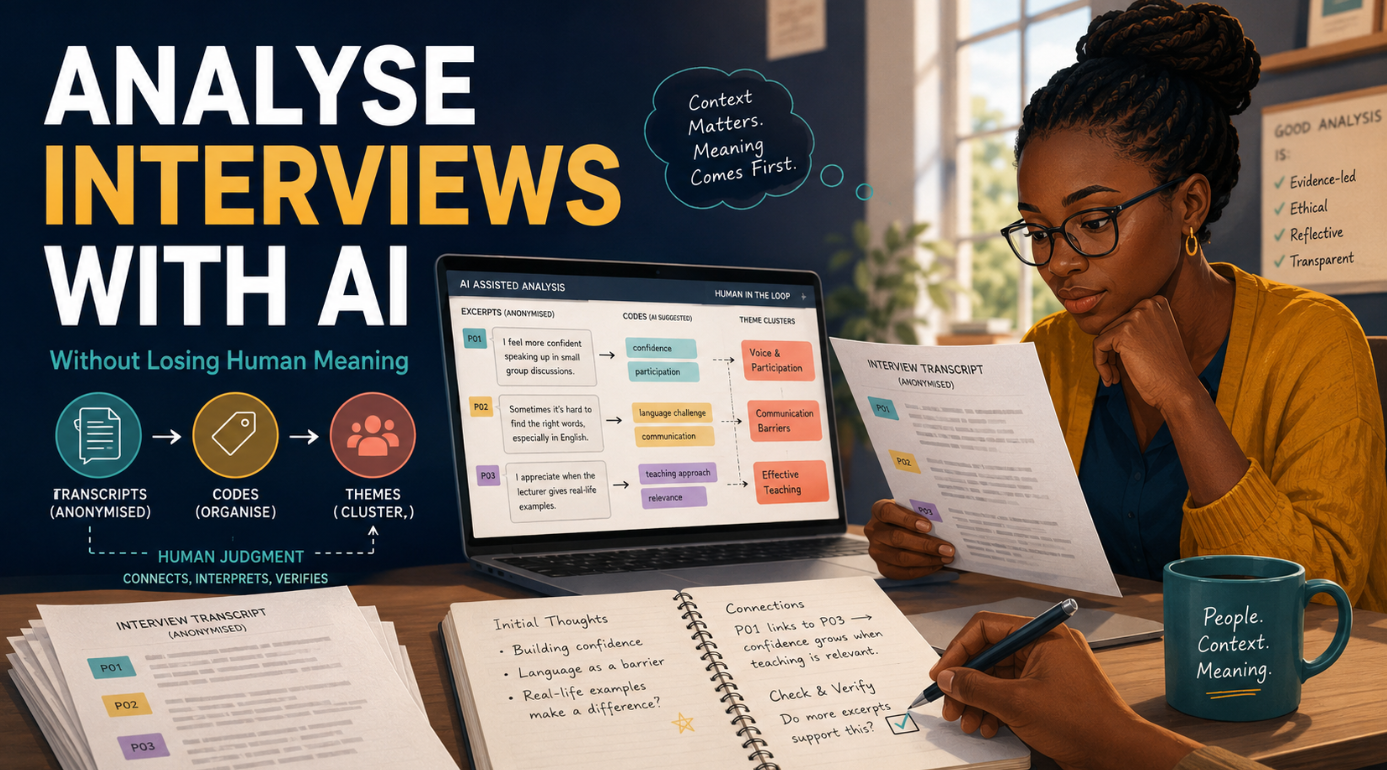
To analyse interview transcripts with AI without losing human meaning:
The non-negotiable rule is: the transcript is the evidence; the AI response is only a suggestion.
A long qualitative project can include hundreds of pages of interviews. Researchers must become familiar with the material, create codes, compare cases, revise categories, identify relationships, select extracts and document their decisions. AI can reduce some of the clerical burden in this work.
However, speed is not the same as understanding. AI systems often favour statements that are explicit, repeated and easy to classify. Qualitative meaning may instead lie in what is unusual, indirect, contradictory or difficult to translate. Frequency can show that an idea appeared often, but it does not prove that the idea is analytically important.
AI may also produce a neat answer when the dataset is uncertain. It can merge distinct experiences, invent a confident explanation, overlook power relations or convert participant language into generic managerial terms. A polished theme such as “Challenges of Digital Transformation” may sound plausible while hiding very different experiences of cost, surveillance, access, gender, status or professional identity.
Research on AI-assisted thematic analysis shows both possibilities and limitations. A 2024 study in the Journal of Medical Internet Research examined whether ChatGPT could support thematic analysis and emphasised the need to align its use with methodological assumptions and researcher oversight. A separate open-access paper on AI-augmented qualitative analysis presents AI as a support within a broader human analytic process rather than an automatic producer of truth.
The debate is especially important for reflexive thematic analysis. In 2025, Braun, Clarke, Jowsey, Lupton and hundreds of other qualitative researchers argued that generative AI is not methodologically congruent with reflexive approaches that depend on a positioned, subjective and reflexive researcher. Their position does not mean that every use of a computer is forbidden. It means a researcher should not claim that an AI independently performed reflexive interpretation. The human researcher’s situated engagement is the method.
“Find the themes” is not a complete method. Before selecting software or writing a prompt, identify the analytic approach used in the proposal, ethics documents and methodology chapter.
| Approach | Main analytic aim | Appropriate AI support | What must remain human |
|---|---|---|---|
| Reflexive thematic analysis | Develop patterns of shared meaning through reflexive engagement | Retrieval, organisation, alternative readings and audit support | Familiarisation, interpretation, reflexivity and theme development |
| Codebook thematic analysis | Apply and refine a structured coding framework | Suggest code matches, compare applications and locate discrepancies | Codebook design, boundary decisions and interpretation |
| Coding-reliability analysis | Apply defined codes consistently across coders | Flag possible passages and calculate structured comparisons | Training, adjudication, validity and final coding decisions |
| Framework analysis | Chart data against cases and predefined or emerging categories | Populate draft matrices and retrieve excerpts | Framework selection, chart verification and explanatory interpretation |
| Qualitative content analysis | Categorise manifest or latent content systematically | Draft classification and counting support | Category validity, contextual interpretation and reporting |
| Grounded theory | Develop concepts and explanatory relationships iteratively | Constant-comparison prompts and memo organisation | Theoretical sensitivity, sampling decisions and theory construction |
| Narrative or discourse analysis | Examine how accounts, language and identities are constructed | Retrieve linguistic patterns or narrative stages | Sequence, performance, power, positioning and cultural interpretation |
If your study says it uses reflexive thematic analysis, do not quietly replace that method with AI-generated topic clustering. If the study uses a predefined codebook, AI may be given those codes—but the researcher must still check every application and justify changes.
For students still designing a study, Iziraa’s guides to the UDSM research proposal format, UDOM research proposal structure and Mzumbe University research proposal format can help align the research question, methodology and analysis plan before data collection begins.
Interview transcripts may contain personal data, confidential organisational information or sensitive experiences. Removing a participant’s name does not automatically make a transcript anonymous. Their job title, institution, village, distinctive event or combination of demographic details may still reveal who they are.
Before using an external AI system, check:
UNESCO’s guidance for generative AI in education and research warns that rapid adoption can outpace privacy protections. The European Commission’s current guidelines on responsible generative AI use in research advise researchers not to provide third-party personal data to external systems without a valid basis, consent where needed and a clear purpose.
If permission is uncertain, stop. Use approved offline software, synthetic excerpts or manual analysis until the supervisor, data-protection officer or ethics committee confirms the acceptable route.
Keep the untouched transcript as the master record. Create a separate working copy for analysis. Replace direct and indirect identifiers with consistent codes such as [P07], [PUBLIC-HEI], [REGION-A] and [MANAGER].
Also consider removing or generalising:
Do not rely on AI to anonymise the same raw file that you are trying to protect. Anonymisation should occur before the text reaches an external service.
Maintain a re-identification key separately in an encrypted, access-controlled location if the study requires one. Never place the key in the same AI project as the anonymised transcripts.
Human familiarisation cannot be outsourced. Listen to the recording where ethically and practically appropriate, read the transcript slowly, correct transcription errors and write initial observations.
Note:
This first reading gives you an interpretive anchor. Without it, an AI summary may become your first—and therefore disproportionately influential—frame for the data.
AI performs better when it receives bounded context, but never include unnecessary identifying details. Prepare a short context sheet containing:
For example, explain that “network” may refer to mobile internet coverage, not professional connections. State that lack of a comment must not be interpreted as agreement. If transcripts combine English and Kiswahili, preserve the original expression beside any translation when its wording matters.
Select one or two information-rich transcripts and code them manually. This is not intended to create a perfect final codebook. It helps clarify what counts as a code, how broad the codes should be and which contextual cues are important.
Record a provisional code as:
| Field | Example |
| Code name | Personal payment for work internet |
| Short definition | Participant pays for data needed to perform institutional duties |
| Include | Data bundles, modem packages or airtime bought for work |
| Exclude | General complaint about weak connectivity without personal payment |
| Example location | P03, lines 118–126 |
| Analytic memo | Cost may be experienced as lack of organisational recognition |
The memo is different from the descriptive code. “Bought a data bundle” is close to the text; “lack of organisational recognition” is an interpretation that must be developed and tested across the dataset.
Provide an anonymised section rather than the entire dataset when possible. Number the transcript lines or paragraphs so every suggestion can be checked.
Use a bounded prompt:
You are assisting with the organisation of anonymised qualitative data. Do not produce final themes or claim to know the participant’s intention. For each passage, suggest up to two concise descriptive codes, quote the relevant words, give the paragraph number and state uncertainty. Preserve contradictions and culturally specific expressions. Research question: [insert]. Method: [insert]. Coding orientation: [inductive/deductive/hybrid]. Transcript section: [paste approved anonymised text]. Return a table with paragraph, extract, suggested code, reason and uncertainty.
The phrase “up to two” matters. Without a limit, AI may over-code every sentence and create an unmanageable list. Requiring a location and excerpt prevents unsupported labels from appearing detached from the source.
Do not automatically add every AI suggestion to your codebook. Create a comparison table:
| Passage | Human code | AI suggestion | Decision | Reason |
| P03:118–126 | Personal payment for work internet | Technology access barrier | Retain human code | AI label hides who bears the cost |
| P05:44–51 | Flexible timing enables care work | Work-life balance | Revise both | “Balance” is too broad; timing and care are central |
| P08:90–94 | Reluctant compliance | Positive adaptation | Reject AI code | Surrounding account contradicts positive framing |
Disagreement is useful. It forces the researcher to explain why one interpretation fits the question and context better. Agreement does not prove truth, and disagreement does not prove that the AI is wrong. Both require return to the transcript.
As coding continues, merge duplicates, split broad codes and record changes. A code such as “technology challenge” may need to become separate codes for unreliable internet, device sharing, personal data costs, software access and limited technical support.
Ask AI to assist with codebook maintenance, not to impose a structure:
Review this researcher-created code list. Identify possible overlaps, vague labels and inconsistent levels of abstraction. Do not merge anything. For each observation, show the affected codes and ask a question the researcher should consider. Code list: [insert].
This form makes the system a critical reader rather than an invisible decision-maker.
A theme is not simply a popular code or a topic heading. It should express a meaningful pattern that answers the research question. “Internet” is a topic. “Academic staff privately subsidise institutional digital work” is a candidate theme because it makes an interpretive claim about the pattern.
For each candidate theme, write:
AI can test a candidate:
Act as a critical qualitative-analysis assistant. Using only the supplied coded excerpts, identify evidence that supports, complicates or contradicts the candidate theme. Do not add facts, count unsupported prevalence or rewrite the theme as final. Candidate theme: [insert]. Coded excerpts with participant IDs and locations: [insert]. Return three sections: support, complications and negative cases.
This is safer than asking, “What are the themes?” because the researcher supplies an emerging interpretation and asks the system to pressure-test it.
AI summaries often move towards the majority pattern. Qualitative rigour also requires attention to cases that do not fit.
Ask:
An AI-produced statement such as “most participants felt supported” is unacceptable unless the dataset and method justify that type of prevalence claim. In qualitative reporting, “several”, “many” and “the majority” should be used carefully and transparently.
Never report an extract based only on an AI output. Open the original transcript and read what came before and after it. Confirm:
This contextual return is where many attractive but weak AI interpretations fail.
A strong qualitative finding usually contains four elements:
AI may help organise your memos or identify repetitive wording, but it should not replace your reasoning. Iziraa’s guide to Chapter Four data analysis and findings and its explanation of the NVivo transcript-to-theme process provide additional support for structuring a transparent findings chapter.
Before accepting a theme, apply the MEANING test:
If a proposed theme fails one of these tests, revise it before reporting.
These prompts should be used only with approved, anonymised material.
Suggest concise descriptive codes for the numbered passages below. Stay close to the participant’s language, provide the exact supporting phrase, state uncertainty and do not infer intention. Do not create final themes. [Add context and text.]
Examine this researcher-created codebook for overlap, vague boundaries and inconsistent abstraction. Do not change it. Return questions and possible risks for the researcher to review.
Compare how participants P01, P04 and P09 describe [issue]. Preserve differences and contradictions. Link every observation to an excerpt and location. Do not claim prevalence beyond these cases.
The candidate interpretation is [claim]. Search only the supplied excerpts for evidence that contradicts, weakens or complicates it. Explain why each extract matters and include its location.
Compare the original Kiswahili expression with the English translation. Identify possible changes in tone, strength, ambiguity or cultural meaning. Offer alternatives, but do not select a final translation without researcher review.
Review the proposed theme definition and included codes. Identify codes that may not share the central organising concept and relevant material that may be excluded. Ask diagnostic questions; do not make the final decision.
Convert these dated researcher memos into a chronological decision log. Preserve all decisions, disagreements and uncertainties. Do not invent reasons or remove unresolved issues.
This creates privacy and ethics risks, especially when participants did not consent to third-party processing. De-identify first and use only approved systems.
The first AI summary can anchor the whole analysis. Human familiarisation should come first.
A rare account may expose a critical mechanism or inequality. Word counts and repeated phrases are clues, not themes.
“Analyse this interview” gives the system permission to choose the method, unit, depth and output. Specify the question, methodology, context and constraints.
Every code and theme should link to participant extracts and locations. A professional-sounding label can still be empty.
Variation often carries the most important meaning. Report the boundaries and exceptions of a pattern.
Never present an AI paraphrase as a participant quotation. Quotes must be checked against the transcript.
Document the tool, version or access date where possible, tasks performed, data safeguards, prompts or protocol, human checks and influence on final decisions. Follow the institution’s disclosure policy.
AI has design assumptions and statistical biases; the researcher also has a position. Rigour comes from transparent, reflexive and evidence-linked decisions—not from pretending either party is neutral.
Keep a secure record of:
Do not publish confidential prompts or protected excerpts simply to demonstrate transparency. Describe the procedure at a level that supports evaluation without exposing participants.
For broader academic-quality checks, see Iziraa’s discussion of free plagiarism-checker risks and guidance on linking Chapter Four evidence to Chapter Five conclusions.
Adapt this statement to the actual procedure and institutional requirements:
An institutionally approved AI system was used as an analytic support tool after transcript de-identification and researcher familiarisation. It assisted with provisional code comparison, retrieval of coded extracts and searches for disconfirming cases. The researcher reviewed every suggestion against the original transcripts and retained responsibility for coding, theme development, interpretation and reporting. No identifiable participant data were entered into the system.
Do not use this wording if it does not accurately describe the study.
Avoid or pause AI-assisted processing when:
Manual analysis using secure qualitative software remains a valid and often preferable choice. The goal is not to use AI because it is available. The goal is to conduct analysis that respects participants and answers the research question convincingly.
AI helps create blank templates, explain coding terminology, generate audit-trail headings or critique a fictional example. No participant data are provided.
An approved system processes de-identified excerpts to suggest descriptive codes, retrieve evidence, compare cases or challenge candidate themes. The researcher verifies every output.
Raw transcripts are uploaded, the system generates final themes, the researcher accepts them without familiarisation and the method is not disclosed. This is not a defensible shortcut.
Most responsible projects should remain at Level 1 or carefully governed Level 2.
They can organise text, suggest codes, compare excerpts and test provisional interpretations. Whether you may upload research data depends on consent, ethics approval, institutional rules and the service’s current privacy arrangements. They should not receive identifiable transcripts by default or replace the researcher’s interpretation.
It can generate plausible topic groupings and candidate interpretations, but “accuracy” in qualitative research is not established by a model’s confidence. Themes must fit the methodology, answer the question and be developed through traceable engagement with the dataset.
NVivo is qualitative data-analysis software that includes organisational, query and, in some versions, AI-assisted features. The software can support a rigorous workflow, but installing it does not automatically make an analysis rigorous. The researcher’s methodological choices and checks remain decisive.
There is no universal number. Data protection comes before convenience. When approved use is possible, smaller anonymised sections are easier to verify and reduce unnecessary exposure. Keep stable participant and paragraph identifiers.
AI may critique or suggest additions to a researcher-created codebook. A deductive codebook should come from the study’s theory, questions and definitions; an inductive system should develop through close reading. Final boundaries remain the researcher’s responsibility.
No. AI systems have their own training and design biases, while qualitative researchers bring theoretical and social positions. Reflexivity, transparency, negative-case analysis and evidence trails make those influences examinable.
No. Participant quotations must come from verified transcripts. AI can locate potential extracts, but every word, speaker and context must be checked.
Keep the original Kiswahili beside working translations where meaning depends on local phrasing. Use bilingual human review, record translation choices and avoid allowing AI to erase idioms, politeness, irony or institutional language. Limited connectivity also makes secure offline or institutionally hosted options worth considering.
Not automatically. The answer depends on university rules and how the system is used. Undisclosed delegation of interpretation or writing may violate policy, while approved, declared support may be acceptable. Check current institutional guidance and preserve evidence of your own analysis.
The best way to analyse interview transcripts with AI is to make AI answerable to the researcher and the researcher answerable to the data. Begin with ethics and methodology, read the transcripts yourself, use anonymised and approved inputs, demand source-linked outputs and treat every suggestion as provisional.
Human meaning survives when context, contradiction, culture and participant voice remain visible throughout the process. It disappears when a convenient summary becomes a substitute for listening. AI can make qualitative analysis more manageable, but only the researcher can make it methodologically coherent, ethically defensible and genuinely meaningful.
For researchers who need additional structured support, Iziraa also provides a broader guide to research and thesis assistance in Tanzania and an example of AI-supported research analysis at UDSM.