Address
Arusha Njiro
Work Hours
80 Hours A week
Address
Arusha Njiro
Work Hours
80 Hours A week

 ByIziraa
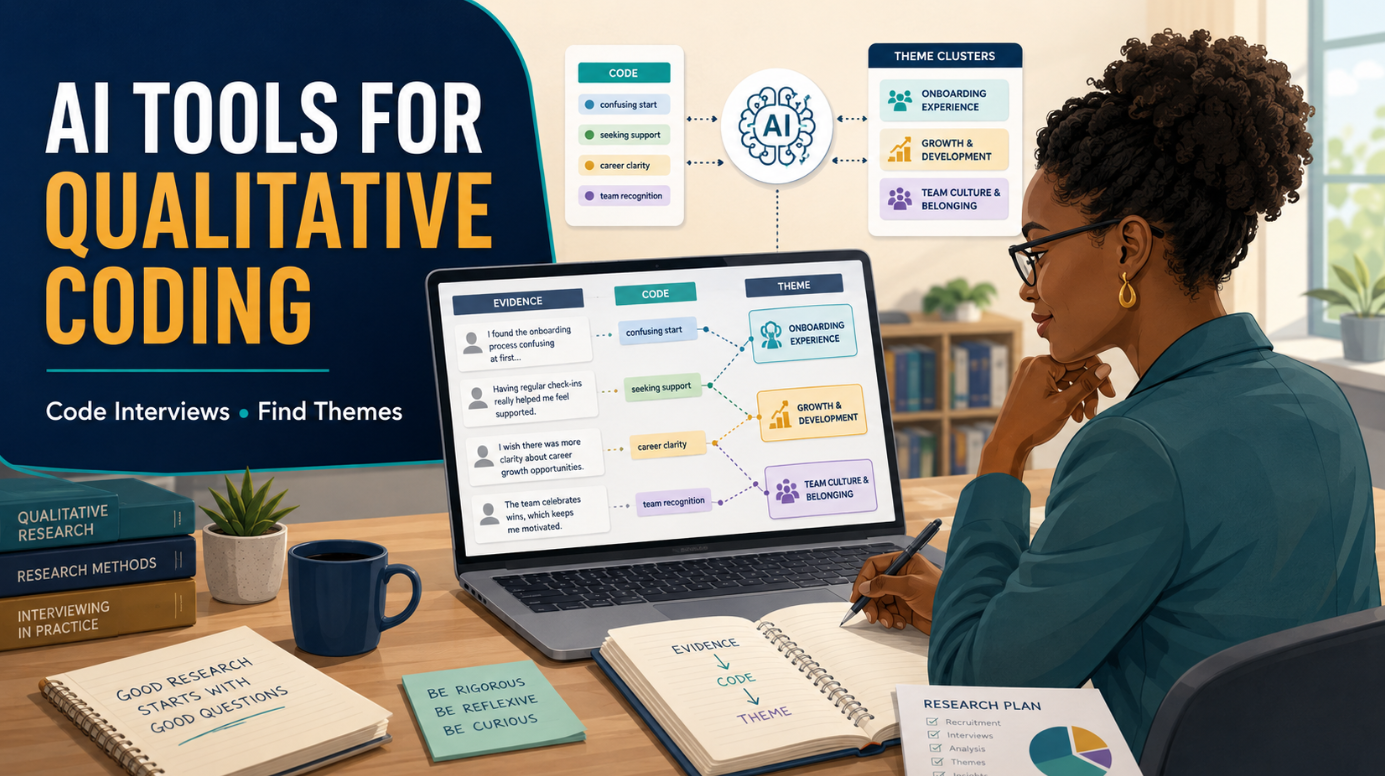
The best AI tools for coding interviews can reduce hours of repetitive work, suggest possible codes and help researchers compare patterns across transcripts. However, no tool can decide automatically what participants’ experiences mean. A convincing qualitative finding still requires a researcher to read the data, examine context, challenge convenient interpretations and connect every theme to evidence.
If you want one direct answer, MAXQDA is the strongest all-round choice for many academic researchers who need AI assistance, manual control, memos, mixed-methods analysis and a visible audit trail. ATLAS.ti is an excellent alternative for intentional AI coding, networks and theory development. NVivo remains attractive where a university or research organisation already uses it. Delve is easier for beginners. Dovetail and Looppanel are better suited to user research, customer interviews and product teams.
The safest choice is not simply the tool that produces themes fastest. It is the tool that allows you to inspect the original quotation, revise the code, record your reasoning and explain exactly how you moved from transcript to conclusion.
| Tool | Best for | Main strength | Important limitation |
|---|---|---|---|
| MAXQDA | Academic and mixed-methods research | AI-assisted coding, summaries, memos and strong manual analysis in one project | Advanced functions and AI add-ons can increase cost and learning time |
| ATLAS.ti | Inductive analysis and theory development | Intentional AI coding, document chat, networks and flexible code relationships | AI suggestions still require line-by-line checking |
| NVivo | Institutions with established NVivo workflows | Mature coding, queries, matrices, multimedia and AI assistance | Can feel complex for a small one-off study |
| Delve | Students and first-time qualitative researchers | Clear interface, manual coding and an AI peer-debriefing approach | Less suitable for highly complex mixed-methods or institutional projects |
| Dovetail | UX, product and customer research teams | Collaborative research repository, transcription and AI-assisted synthesis | Designed more for organisational insights than traditional dissertation workflows |
| Looppanel | Rapid analysis of user interviews | Records, transcribes, takes notes and helps cluster interview evidence | Less appropriate when a thesis requires detailed methodological control and specialist QDA outputs |
Best overall for academic research: MAXQDA
Best for flexible AI coding and visual relationships: ATLAS.ti
Best if your institution already supports it: NVivo
Best for beginners: Delve
Best for a shared UX research repository: Dovetail
Best for rapid user-interview workflows: Looppanel
In this article, coding interviews means analysing qualitative interviews—not practising for a software-engineering interview.
Qualitative coding involves attaching a short label to a meaningful segment of data. For example, a lecturer might say that online teaching allows flexibility but requires personally financed internet bundles. A researcher could initially code that excerpt as work flexibility, personal data cost and cost transfer to employee.
Codes help organise the material. Categories bring related codes together. Themes go further by expressing a meaningful pattern that answers the research question. A group of codes such as personal data spending, laptop repair, electricity and unpaid preparation time might contribute to a theme such as hidden cost externalisation in remote teaching.
A frequently mentioned word is not automatically a theme. A theme must have a coherent central idea, enough supporting evidence and a clear relationship to the research question. This distinction matters because AI tools are often very good at counting, summarising and grouping similar language, but less reliable at interpreting silence, contradiction, power, culture, irony or an unexpected case.
Researchers preparing a dissertation may also find Iziraa’s guide to SPSS, Stata, NVivo and AI-assisted dissertation analysis useful for placing qualitative work within the wider analysis process.
AI can assist with several time-consuming tasks:
AI cannot take responsibility for the study. It does not know the field context unless the researcher provides it. It may flatten different experiences into one broad category, overlook minority positions, treat fluent speech as more important than hesitant speech, or produce a persuasive summary that is not fully supported by the transcripts.
The correct principle is simple: AI proposes; the researcher verifies, interprets and decides.
This is also why a general chatbot should not receive identifiable interview transcripts unless the research ethics approval, participant consent, institutional policy and service terms clearly permit that use. For broader privacy controls, see Iziraa’s guide to academic integrity and responsible AI use.
MAXQDA is the strongest all-round recommendation for researchers who want traditional qualitative analysis plus carefully integrated AI assistance. It supports interview transcripts, focus groups, documents, spreadsheets, PDFs, audio, video, images and mixed-methods data.
Its normal qualitative tools remain important: researchers can create code systems, drag codes onto excerpts, write linked memos, retrieve coded segments, compare groups and build visual maps. The AI layer sits on top of that structure. According to the official MAXQDA AI Assist documentation, AI Coding can recommend relevant text segments and provide comments explaining the basis of suggestions. MAXQDA also supports summaries, document chat and conversations about coded material.
MAXQDA does not force the researcher to choose between entirely manual analysis and one-click automated themes. A researcher can begin with open coding, ask AI to suggest additional codes, compare the suggestions with the human codebook, reject weak recommendations and record the decision in a memo.
It is especially useful for explanatory sequential mixed-methods studies. Quantitative survey results can be organised alongside interviews, allowing the researcher to explore how qualitative experiences explain statistical relationships. MAXQDA’s summary grids and code matrices can also help compare institutions, ranks, gender groups or other cases without detaching findings from their source excerpts.
The extensive feature set can initially feel demanding. AI functions may be sold or limited separately from the core licence, so researchers should check the current plan rather than assume every advertised feature is included. More importantly, an AI comment is still a suggestion—not methodological justification.
Choose MAXQDA when: you are conducting a thesis, PhD, evaluation or mixed-methods project and need rigorous manual tools plus optional AI support.
ATLAS.ti is a close competitor to MAXQDA. It is particularly attractive when the analysis depends on exploring relationships among codes, categories, cases and concepts.
The official ATLAS.ti platform offers intentional AI coding, document conversations, AI summaries, transcription and code management. Intentional AI coding allows the researcher to provide an analytical purpose rather than accepting generic topic labels. Its interview-analysis guidance describes the ability to generate descriptive codes from transcripts while keeping the researcher in control.
Its network views can help researchers examine how codes relate. Suppose interviews reveal digital competence, autonomy, workload and social isolation. A network can show whether autonomy is experienced as beneficial only when internet reliability and institutional support are adequate. That moves analysis beyond a list of repeated topics.
ATLAS.ti is also suitable for iterative coding. Researchers can merge overlapping codes, split codes that have become too broad, write definitions, link memos and inspect quotations supporting each theme. The AI can offer a second analytical perspective, while the project structure preserves the researcher’s revisions.
Intentional prompts can shape the results strongly. If a researcher tells the AI to find evidence that remote work improves satisfaction, the system may prioritise confirming extracts. A better instruction asks for supporting, contradicting and ambiguous evidence.
Choose ATLAS.ti when: you want flexible coding, visual conceptual networks and AI assistance guided by explicit research intentions.
NVivo has long been used in universities, government studies, health research and programme evaluation. Its continuing advantage is the depth of its qualitative toolkit: coding, cases, classifications, queries, matrices, comparisons, multimedia and mixed-methods connections.
The current NVivo product information describes AI assistance for identifying themes and accelerating evidence-based qualitative work. Automated functions can help researchers process a large document collection, while normal NVivo queries enable deeper exploration of coding patterns.
If a university already provides licences, training, templates and supervisor familiarity, NVivo may be the most practical choice. Methodological quality depends partly on whether the researcher can use the software confidently. An established institutional workflow can be more valuable than switching to a fashionable tool with unfamiliar data policies.
NVivo is also useful for projects with multiple forms of evidence. A researcher can combine transcripts, policy documents, observation notes, open-ended survey responses, audio and video within a structured project. Matrix coding queries can compare patterns across participant types or sites.
NVivo can be more than a beginner needs for a small study. The learning curve, licensing model and collaboration options should be reviewed before committing. Automated coding may generate an initial map, but a thesis examiner will still expect the researcher to explain code development, theme refinement and interpretive decisions.
Choose NVivo when: your institution already supports it, your study contains varied media, or you need mature queries and case comparisons.
For a broader view of how NVivo fits into a dissertation, see Iziraa’s Chapter Four data analysis and findings guide.
Delve is designed to make qualitative coding easier to learn. It provides a clean environment for importing transcripts, highlighting excerpts, applying codes, grouping codes into categories and developing themes.
Its official qualitative analysis platform presents the AI assistant as a peer debriefer. That is a useful model: instead of treating AI as an automatic answer machine, the researcher uses it to consider alternative interpretations, refine code definitions and test assumptions.
Beginners often struggle because complex software distracts them from reading and thinking. Delve keeps the coding process visible. A student can open a transcript, select an excerpt, attach a code, add a memo and gradually develop a code hierarchy.
The AI assistant can help ask questions such as:
Ease of use does not remove the need to inspect data-hosting, privacy and export options. Some institutions approve only named software or require local storage. Researchers should verify whether Delve’s current processing arrangements match their ethics protocol before uploading sensitive material.
Choose Delve when: you are new to thematic analysis, your dataset is mainly text and you value simplicity over advanced mixed-methods functions.
Students still designing their study can connect the software decision to the methodology section using Iziraa’s research and thesis assistance guide.
Dovetail is not primarily a traditional dissertation package. It is an AI-powered customer-insights and research repository used by product, design and organisational teams. It can centralise interviews, notes and research findings, making evidence searchable and reusable.
The Dovetail research platform supports transcription, highlights, tags, summaries and team collaboration. Its biggest advantage is not simply analysing one project. It helps a team connect current interviews with earlier studies, customer feedback and existing evidence.
In organisational research, valuable interviews are often forgotten after a presentation. A repository can preserve clips, quotations, tags and findings so another team can discover them later. This makes Dovetail useful for product discovery, user experience, service improvement and customer research.
It is also easier to share a traceable insight with non-research colleagues. A product manager can move from a theme to the supporting highlight and then to the interview source rather than receiving a conclusion without evidence.
Dovetail’s workflow reflects product and organisational research more than the conventions of a qualitative thesis. Academic researchers should confirm that the exports, memoing, codebook controls and audit evidence meet their methodological needs. AI summaries can make findings look complete before the team has examined contradictions or contextual differences.
Choose Dovetail when: your team conducts repeated customer or user studies and needs one searchable, collaborative evidence repository.
Looppanel is built around the practical workflow of conducting and analysing user interviews. It can help with recording, transcription, notes, clips, tagging and synthesis.
That integrated process is useful when a small product team needs to analyse many interviews quickly. Instead of moving files from a meeting platform to transcription software, then to a coding package and finally to a presentation tool, the team can keep more of the workflow in one place.
The tool is designed around sessions and evidence. Researchers can revisit the recording, inspect the transcript and group observations. AI-generated notes can offer a starting point for synthesis, while tags and clips support communication with the wider team.
Speed can create false confidence. A concise AI note may omit the participant’s conditions, hesitation or qualification. Teams should compare every important insight with the recording or transcript. Academic researchers must also assess whether the platform supports the detailed audit trail, memoing and methodological reporting required by their institution.
Choose Looppanel when: you conduct frequent product or UX interviews and need a fast route from recording to evidence-backed team insights.
General AI assistants can help explore a carefully prepared, anonymised dataset, but they are not direct substitutes for qualitative data analysis software.
They can be useful for:
They are weaker when you need persistent links between every code and quotation, inter-coder comparison, complex case classifications, reproducible queries or a complete audit trail. Their responses can also change between runs.
Do not paste raw names, telephone numbers, email addresses, organisations, exact job titles or recognisable stories into a general chatbot. Remove identifiers first, confirm institutional rules and use the most restrictive suitable data settings. If the data is highly sensitive, use approved local or enterprise arrangements—or do not upload it.
The following process combines speed with methodological control.
Check transcription accuracy against the audio, especially names, technical terms and local expressions. Replace direct identifiers with participant codes such as P01 or HEI-A-L1. Record the anonymisation decisions separately from the analysis file.
Do not assume automated transcription handles Tanzanian English, Kiswahili, code-switching, accents or institutional abbreviations perfectly. A single incorrect word can reverse the meaning of a quotation.
Read several contrasting transcripts before asking AI to code the whole dataset. Write initial memos about context, surprising statements, possible concepts and your own assumptions. This familiarisation prevents the software’s first suggestions from becoming the unquestioned frame.
Define each deductive code using the research questions or conceptual framework. For inductive analysis, develop provisional codes from close reading. Include:
Use two or three transcripts that represent different participant groups. Compare the AI suggestions with your manual coding. Note false inclusions, missed meanings and overly broad codes. Revise the code definitions before scaling up.
Do not approve hundreds of AI codes in one click. Check the original context around each important excerpt. Reject irrelevant suggestions, split broad codes and preserve unusual cases rather than forcing them into the dominant pattern.
Group related codes, but ask what central idea connects them. Then actively search for evidence that weakens or contradicts each candidate theme. Compare themes across institutions, participant ranks, age groups, locations or other relevant cases.
Keep versions of the codebook, memos, AI prompts, rejected suggestions, theme maps and decisions. In the methods section, disclose which tool and feature were used, what data it processed, how the researcher checked outputs and what remained entirely human-led.
This workflow can support the findings-writing stage described in Iziraa’s Chapter Four guide, but software output should never be pasted into a dissertation as if it were interpretation.
These prompts can be adapted inside an approved qualitative tool. Replace the bracketed text with your study information.
Review the selected transcript only for the code [CODE NAME]. Definition: [DEFINITION]. Include excerpts when [INCLUSION RULE]. Exclude excerpts when [EXCLUSION RULE]. Return candidate excerpts with a brief reason and mark uncertain cases. Do not create evidence that is absent from the transcript.
The current interpretation is [PROPOSED INTERPRETATION]. Find excerpts in the selected transcripts that contradict, qualify or complicate it. Explain why each excerpt matters and identify the participant code. Do not treat silence as agreement.
Compare the codes [CODE A] and [CODE B] using their definitions and coded excerpts. Identify overlap, ambiguity and misclassified excerpts. Recommend clearer inclusion and exclusion rules without changing the source text.
Compare how [GROUP A] and [GROUP B] discuss [TOPIC]. Separate similarities, differences, exceptions and missing evidence. Link every statement to a participant code and excerpt.
Evaluate the candidate theme [THEME NAME]. Its proposed central idea is [CENTRAL IDEA]. Assess whether the supporting codes form a coherent pattern, identify weak or contradictory evidence, suggest a sharper boundary and state what the theme does not claim.
These prompts work because they constrain the task, request evidence and invite contradiction. “Find the themes in these interviews” is much weaker because it gives the model no research question, code definitions, analytical approach or quality criteria.
Before choosing a platform, use the TRACE test.
Can you click from a theme to the code, excerpt, transcript and participant? Avoid tools that produce attractive conclusions without visible supporting data.
Can you edit, reject, merge and split AI suggestions? Can you continue coding manually? The researcher should control the codebook and final interpretation.
Can the system preserve memos, code changes, versions and exports? A rigorous analysis requires evidence of how decisions developed.
Where is data stored and processed? Is it used to improve models? Can files be deleted? Does the plan offer the security and contractual terms your ethics approval requires?
Can you export transcripts, codes, excerpts, memos and tables in usable formats? A project should not become trapped in one platform.
If a tool fails traceability or confidentiality, impressive automatic themes should not rescue it.
Interviews may combine English, Kiswahili and local expressions. AI can translate literal words while missing social meaning. Retain the original-language quotation, document translation decisions and involve a fluent human reviewer. If the article or thesis uses an English translation, explain who translated it and how accuracy was checked.
Cloud tools may be inconvenient where connections are unstable or data costs are high. Desktop software with local project storage can be preferable, although particular AI features may still require internet access. Test the real workflow before purchasing a licence.
International subscription prices can become expensive after exchange rates, taxes and card charges. Ask the university library, department or research office whether it already provides MAXQDA, ATLAS.ti or NVivo. A supported institutional licence may offer better value than an apparently cheaper personal tool.
Anonymisation does not automatically make every upload acceptable. The consent form, ethics application and data-management plan should describe who can access recordings and transcripts, where they are stored and whether automated processing is involved. If the approved protocol did not anticipate external AI processing, seek institutional guidance before changing the workflow.
Researchers developing proposals at Tanzanian institutions may consult Iziraa’s guides to the UDSM research proposal format, UDOM research proposal format and Mzumbe research proposal format while still checking the latest official university requirements.
The first output is an analytical proposal. Review it against the research question and entire dataset.
A rare account can expose an institutional failure or explain a statistical pattern. Importance depends on meaning and relevance, not only counts.
An excerpt can mean something different when separated from the question, preceding statement or participant background. Always read around the coded passage.
If the software names the first codes, the researcher can become anchored to its categories. Manual reading creates an independent basis for comparison.
AI does not remove subjectivity. Its training, prompts, settings and clustering choices introduce additional influences. Qualitative quality comes from reflexivity and transparency, not pretending interpretation disappeared.
Research participants did not consent merely because a tool is convenient. Apply the approved data-management plan and remove unnecessary identifiers.
“The interviews were analysed in NVivo” does not explain the analysis. Report the analytical approach, coding process, theme development, researcher roles, quality checks and use of AI.
A transparent description might cover the following:
Interview transcripts were anonymised and imported into [software and version]. The researcher manually read all transcripts and developed an initial codebook from the research questions and open coding of a varied sample. [Named AI feature] was then used to suggest candidate excerpts matching researcher-defined codes. Every suggestion was checked against the surrounding transcript and accepted, revised or rejected by the researcher. AI-generated summaries supported comparison but did not determine the final themes. Codebook versions, analytic memos and decisions were retained as an audit trail.
Adapt this statement to what actually happened. Do not claim manual coding if suggestions were accepted automatically. Do not claim AI analysis if the tool only provided transcription or keyword search.
Academic integrity also extends to the written report. Iziraa’s guide to passing plagiarism and AI checks responsibly can support the final review, but the strongest protection is original analysis, accurate citation and transparent disclosure.
For most thesis and mixed-methods researchers, MAXQDA is the best overall AI tool for coding interviews and developing qualitative themes because it combines strong manual analysis, memos, visualisation, mixed-methods functions and controlled AI assistance. ATLAS.ti is equally compelling for intentional coding and conceptual networks. NVivo is the practical choice when institutional support and existing expertise already surround it.
For a beginner working mainly with transcripts, Delve offers the clearest route into systematic coding. For UX and product teams, Dovetail is stronger as a reusable research repository, while Looppanel is useful for moving rapidly from recorded interviews to evidence-backed synthesis.
The most trustworthy workflow remains human-led. Read the transcripts, define the analytical question, test AI on a small sample, inspect every important excerpt, search for contradictions and preserve the decisions that produced the final themes. The winning tool is not the one that removes the researcher. It is the one that helps the researcher think more carefully while keeping the evidence visible.