Address
Arusha Njiro
Work Hours
80 Hours A week
Address
Arusha Njiro
Work Hours
80 Hours A week

 ByIziraa
Searching with AI feels wonderfully efficient until you click the citations. Sometimes the source is an official report that supports the sentence perfectly. However, another citation may lead to a thin blog post, a paywalled page or an article that never makes the claimed point.
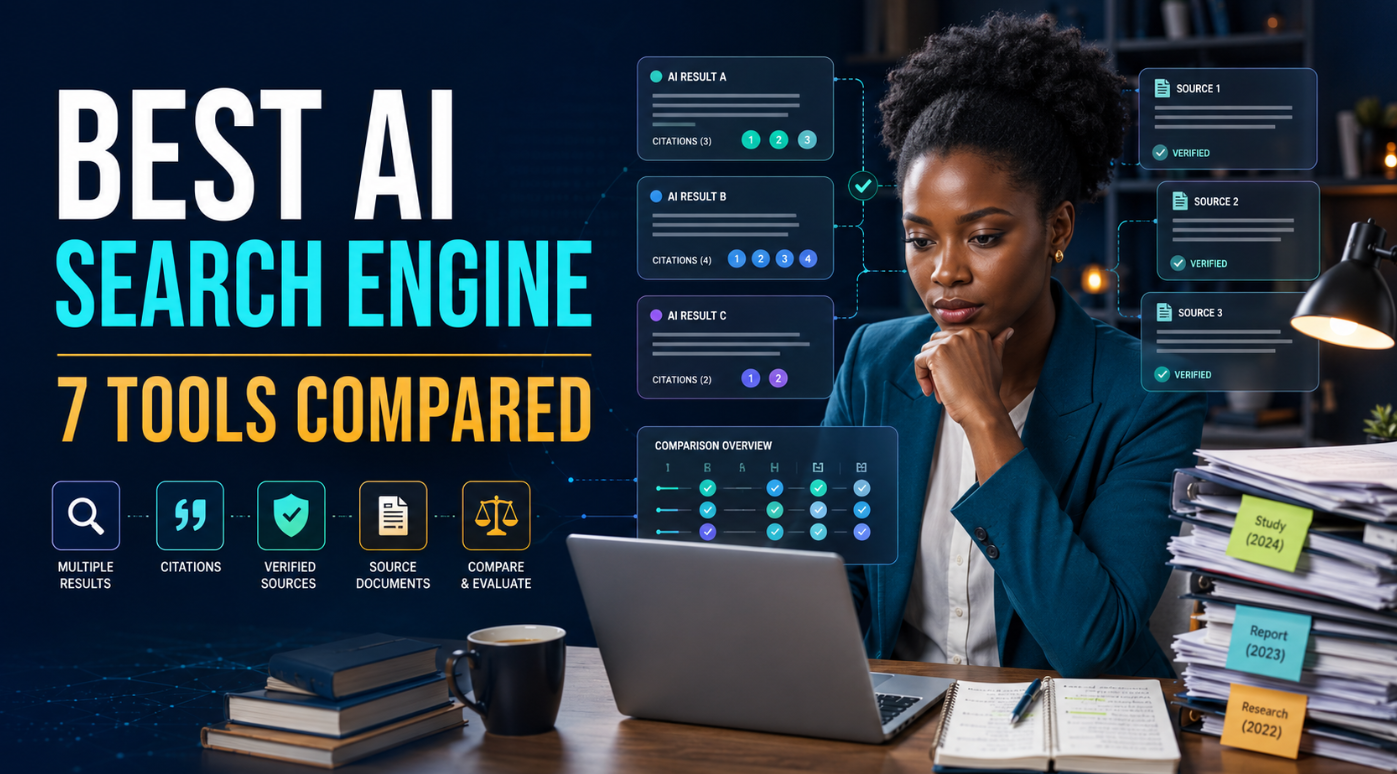
So, which is the best AI search engine for sources? For general web research, Perplexity is the strongest starting point because it makes citations prominent and easy to inspect. Nevertheless, it is not the winner for every task. Elicit is better for evidence extraction from research papers, Consensus is better for quickly understanding what peer-reviewed studies collectively suggest, Google AI Mode is better for broad web discovery, and ChatGPT Search is better for turning selected sources into a clear explanation.
That distinction matters. The best-looking answer does not necessarily contain the best evidence. Likewise, the tool with the most citations may simply repeat many weak sources. Therefore, this comparison judges the source trail rather than the elegance of the AI-written paragraph.
If you need one recommendation, start with Perplexity for general research and Elicit for academic research. Then open the important citations yourself. This two-tool approach is safer than expecting one AI search engine to understand every type of evidence.
| Research need | Best starting tool | Why it stands out | Main caution |
|---|---|---|---|
| General web research | Perplexity | Prominent, frequent and clickable citations | Citation quantity can hide uneven quality |
| Clear source-backed explanation | ChatGPT Search | Strong synthesis and useful follow-up dialogue | You must ask it to prefer primary sources |
| Broad discovery and fresh information | Google AI Mode | Wide search reach and query fan-out | Sources may be less central than the generated answer |
| Work and Microsoft information | Microsoft Copilot | Web grounding plus Microsoft 365 context | Best features depend on account and administrator settings |
| Quick scientific consensus | Consensus | Searches scholarly literature and summarises study patterns | “Consensus” can conceal differences in study quality |
| Literature review and evidence extraction | Elicit | Paper search, structured extraction and detailed evidence links | Primarily academic, with weaker coverage outside research literature |
| Private, independent web discovery | Brave Search | Independent index and cited AI answers | Less suited to formal academic synthesis |
There is an important limitation to this verdict. This is an editorial, feature-based comparison using current official documentation and repeatable source-quality criteria; it is not a laboratory benchmark of every possible query. Results change with the question, location, language, subscription and date. Consequently, readers should test two tools with the same important question before relying on either answer.
A source is not strong merely because it appears after a superscript number. Instead, a useful source should let you move from an AI claim to evidence that genuinely supports it.
For this comparison, each tool is judged with the SOURCE test:
For example, a Tanzanian job seeker researching a new application rule should prefer the employer, regulator or government notice over a copied social post. Similarly, a student studying the effect of remote learning should prefer the original journal paper over an SEO article that mentions the paper without explaining its method.
This is also why AI research should be treated differently from ordinary drafting. If your goal is writing rather than searching, the guide to AI tools for WordPress bloggers explains how research, editing, visual creation and publishing fit together. Meanwhile, this comparison stays focused on the evidence-discovery stage.
Perplexity is the strongest overall option when a reader wants sources displayed as part of the answer rather than hidden behind a separate search page. Its official explanation says that answers include numbered citations linking to original sources. In addition, its source panels can label some domains as government, academic or trusted, which helps users perform a quick first check.
The interface encourages healthy research behaviour. You can scan the answer, inspect the source cards and continue with a narrower follow-up question. As a result, Perplexity often feels more like a research notebook than a traditional list of blue links.
However, visible citations do not guarantee strong citations. A response may mix a government publication, a news report, a company blog and an anonymous content site as though they carry equal authority. Moreover, a citation can support only part of a long sentence. The reader must still open it and check the exact wording.
Best for: current events, product comparisons, background research, travel discovery and finding an initial reading list.
Less suitable for: a final academic literature review without database searching, quality appraisal and reference checking.
Prompt to improve its sources:
Answer using primary sources first. Prioritise official institutions, original studies, regulations and first-party product documentation. Place a citation after every factual claim, and label any point supported only by a secondary source.
Verdict: Perplexity is the best AI search engine for sources when citation visibility and fast verification are the main priorities. Still, its answer should begin the research process rather than end it.
ChatGPT Search is especially useful when the task involves both discovery and explanation. According to official OpenAI documentation, search responses can include inline citations, while the Sources panel provides cited and related links. ChatGPT may also rewrite one question into several targeted searches, which can uncover information that a single literal query misses.
Its greatest strength is synthesis. You can ask it to compare two official policies, identify a disagreement among sources, rewrite a technical explanation for a beginner or organise findings into a table. Furthermore, the conversational format makes it easy to challenge the first response: “Which claim has the weakest support?” or “Replace all secondary sources with original documents.”
Nevertheless, the first answer may not automatically use the evidence standard you need. A broad prompt can produce a mix of primary and secondary sources. Therefore, a careful user should specify acceptable domains, publication dates and evidence types.
ChatGPT Search also fits naturally into a wider learning workflow. The article on ChatGPT Study Mode explains why receiving a clear answer is not the same as understanding it. Likewise, a well-cited response is not the same as verified research.
Best for: explaining complex topics, comparing selected sources, producing an evidence map and continuing research through follow-up questions.
Less suitable for: automatically generating a submission-ready academic bibliography without checking authors, titles, dates and DOIs.
Prompt to improve its sources:
Search the web before answering. Use primary and authoritative sources wherever possible. For each conclusion, show the supporting source, publication date and one sentence explaining why that source is credible. Separate verified facts from your inference.
Verdict: ChatGPT Search can be the best AI search engine for sources when the real need is turning verified evidence into an understandable narrative. Perplexity exposes citations more aggressively, whereas ChatGPT often provides the better guided explanation.
Google AI Mode benefits from Google’s search infrastructure and its ability to fan one question into several related searches. Google’s official AI Mode guidance explains that the system divides a question into subtopics, searches for them simultaneously and returns an AI response with links for further exploration.
That breadth makes Google valuable for unfamiliar or rapidly changing topics. For instance, a search about scholarships may need university pages, government guidance, application dates, news and local context. Google can expose several parts of that information landscape quickly.
Moreover, conventional search results remain nearby. This matters because sometimes the safest research move is to ignore the summary and visit the official source directly. Google itself advises users to check important information in more than one place.
On the other hand, an AI Overview or AI Mode response may make the generated summary feel more important than its evidence. Links can support broad exploration without clearly mapping every sentence to a specific passage. In addition, high-ranking web pages are not automatically authoritative; popular summaries can outrank original evidence.
Best for: broad topic discovery, fresh local information, shopping or travel exploration, and finding official pages when you know what institution should own the fact.
Less suitable for: precise claim-by-claim evidence extraction from a small set of documents.
Better search instruction:
Show official and primary sources for this question. Exclude copied summaries and low-authority content sites. Give me the original regulation, dataset, research paper or organisation page before commentary about it.
Verdict: Google AI Mode may be the best AI search engine for sources during broad discovery. However, Perplexity and Elicit make the evidence trail easier to audit afterwards.
Microsoft Copilot becomes particularly useful when research lives partly on the public web and partly inside Microsoft 365. Microsoft explains that web search in Copilot grounds responses in current publicly available information. Meanwhile, eligible workplace configurations can connect answers to documents, emails, meetings and other authorised organisational content.
This combination can save time. For example, a team may ask Copilot to compare a new public regulation with an internal policy document. Instead of manually switching between browser tabs and company files, the user can inspect citations within one workflow.
Yet this advantage is conditional. Access depends on the Microsoft product, licence, administrator controls and permissions. More importantly, a workplace file is not authoritative merely because it is internal. An old draft policy can be less reliable than a current signed version.
Social media managers and virtual assistants should also recognise the permission risk. The guides to AI tools for virtual assistants and AI tools for social media managers both emphasise that client information should not be pasted into unapproved systems.
Best for: Microsoft-centred organisations, authorised internal research, policy comparison and work-document retrieval.
Less suitable for: users who only want a simple public-web answer engine.
Prompt to improve its sources:
Distinguish public-web evidence from internal work files. Cite each claim, show the date and owner of every internal document, and warn me if two sources conflict or if a file appears outdated.
Verdict: Microsoft Copilot is not the universal winner, but it may be the best AI search engine for sources in an organisation whose trusted evidence already lives in Microsoft 365.
Consensus is built for questions that should be answered through scientific research rather than the open web. Its official materials describe it as an academic search engine that retrieves scholarly papers and generates cited syntheses. Therefore, it reduces a common research problem: an ordinary AI search engine may cite health blogs or commercial articles when the user actually needs peer-reviewed studies.
The tool is particularly helpful for questions such as, “Does flexible work improve job satisfaction?” or “What does research say about retrieval practice?” It can surface relevant papers and help a reader see whether findings broadly agree, disagree or depend on context.
However, “peer reviewed” does not mean “correct”. Studies can use small samples, weak measures, inappropriate comparisons or outdated evidence. Furthermore, a majority pattern may conceal an important high-quality minority result. The user should inspect research design, population, date and limitations rather than relying on a simplified consensus indicator.
This caution is especially important when analysing research for publication. The guide on analysing interview transcripts with AI shows why tools can organise evidence without replacing human interpretation. The same principle applies to literature synthesis.
Best for: quick academic discovery, evidence-informed questions and locating peer-reviewed papers in accessible language.
Less suitable for: current news, product information, laws, local services or topics that are not well represented in scholarly literature.
Prompt to improve its sources:
Find peer-reviewed studies that directly answer this question. Separate systematic reviews, experiments and observational studies. Show the population, year, sample size and principal limitation for each key paper.
Verdict: Consensus can be the best AI search engine for sources when a reader wants the broad direction of published research. Nevertheless, Elicit is stronger when the researcher needs structured extraction and closer inspection.
Elicit is designed for researchers who need to move beyond “find me some papers”. Its official source documentation states that it searches more than 138 million academic papers from sources including Semantic Scholar, PubMed and OpenAlex. In addition, its workflows support natural-language paper search, structured comparison and evidence extraction.
Its source advantage is granularity. Instead of producing only a smooth summary, Elicit can help users compare study details in a table. Its systematic-review materials also describe sentence-level links between generated claims and the underlying paper text. Consequently, it is easier to ask, “Where exactly did this conclusion come from?”
Elicit is particularly useful during literature screening, evidence mapping and data extraction. A researcher can define fields such as country, sample, method, intervention and outcome, then compare papers more systematically than in a normal chat response.
Still, automation does not remove review work. Metadata can be incomplete, extracted values can be wrong and relevant studies can be missed. Moreover, Elicit’s documentation notes that its corpus is largely optimised for English-language material. A Tanzanian researcher may therefore need AJOL, institutional repositories, local journals and manual database searches to capture regional evidence.
Best for: literature reviews, evidence tables, systematic-review assistance and tracing claims into research papers.
Less suitable for: everyday web questions, breaking news and broad local discovery.
Prompt to improve its sources:
Find studies directly relevant to this research question. Create columns for country, setting, sample, design, variables, findings and limitations. Do not infer missing values; mark them as not reported and link every extracted claim to the paper text.
Verdict: Elicit is the best AI search engine for sources when serious academic evidence extraction is the priority. Yet researchers should still search additional databases and verify every crucial field against the full paper.
Brave Search provides an alternative to search experiences built primarily on Google or Bing. Brave says its AI answer service grounds responses in real-time web results with verifiable citations, while its search infrastructure uses an independent index. That independence can produce a meaningfully different set of pages from the larger search ecosystems.
This makes Brave valuable as a second search engine. If Google, ChatGPT and Perplexity keep repeating the same publishers, Brave may expose a source that their shared retrieval patterns overlooked. Moreover, privacy-conscious users may prefer its broader product philosophy.
Nevertheless, diversity is not the same as authority. An independent index can still retrieve weak pages, and Brave is not a specialist academic database. Therefore, its best role is often triangulation: use it to challenge the source list from another engine.
Best for: independent web discovery, privacy-conscious searching, technical queries and checking whether mainstream engines overlooked relevant pages.
Less suitable for: a complete scholarly evidence review or high-stakes decisions without additional verification.
Prompt to improve its sources:
Prioritise original and authoritative sources. Group results as official, academic, news and commentary. Explain which source directly supports each factual conclusion and identify any claim that lacks primary evidence.
Verdict: Brave Search may be the best AI search engine for sources when an independent index and source diversity matter. It may not replace Perplexity or Elicit, but it is an excellent second opinion.
One overall league table would create false precision. Instead, the most useful ranking matches the engine to the evidence problem.
| Position | Tool | Source-quality strength | Choose it when… |
| 1 | Perplexity | Visible, frequent web citations | You want fast general research with an inspectable trail |
| 2 | ChatGPT Search | Strong source synthesis and follow-up | You need to understand, compare or explain verified material |
| 3 | Elicit | Detailed scholarly evidence extraction | You are building a literature review or evidence table |
| 4 | Google AI Mode | Broad and fresh web discovery | You need wide coverage, local context or multiple subtopics |
| 5 | Consensus | Accessible synthesis of scholarly findings | You want a quick view of what peer-reviewed studies suggest |
| 6 | Microsoft Copilot | Web plus authorised work grounding | Your evidence sits across Microsoft 365 and public sources |
| 7 | Brave Search | Independent index and source diversity | You want a privacy-focused alternative or second source set |
This order should not be interpreted as a permanent accuracy score. For example, Elicit ranks below ChatGPT for general users but above it for structured literature extraction. Likewise, Copilot can move to first place inside a well-governed Microsoft workplace.
Before searching, ask who should know the answer first. A company owns its current product documentation. A regulator owns its rules. A research team owns its study. A national statistics office owns its official dataset. This simple question helps you recognise when an AI engine has returned commentary instead of evidence.
Use plain instructions such as “prioritise original studies, official documents and first-party pages”. Otherwise, the engine may optimise for readability or popularity. Furthermore, specify a date range when the topic changes quickly.
Do not judge the evidence from the source title alone. Open the page, confirm the author or institution, inspect the publication date and locate the relevant passage. If you cannot find the claim, treat it as unsupported.
A citation placed after a paragraph may support only one sentence. Therefore, break complicated claims into smaller parts. Check numbers, comparisons, dates and causal statements separately.
For consequential facts, use a second source that does not merely repeat the first. Better still, search with another engine. Perplexity plus Brave can diversify the open-web search, while Elicit plus a scholarly database can strengthen academic discovery.
Save the source title, URL, author or institution, publication date, relevant claim and access date. This small audit trail prevents you from citing an AI answer as though it were the original evidence.
Once the evidence is verified, return to the original material. Paraphrase accurately, preserve uncertainty and cite the source itself. For blog production, the guide to AI tools for qualitative coding offers a similar principle: automation may organise evidence, but the human remains responsible for meaning.
Research [topic]. Prioritise official documents, original datasets, peer-reviewed studies and first-party technical documentation. Exclude content farms and copied summaries. For every major claim, give the direct source and publication date.
Audit your previous answer one claim at a time. For each factual sentence, show which citation supports it and quote no more than a short identifying phrase. Mark the claim unsupported if the source does not directly establish it.
Find the strongest credible evidence supporting and challenging this conclusion. Separate facts, expert interpretation and your own inference. Explain why the sources disagree.
Find relevant peer-reviewed studies and create a table with author, year, country, sample, design, main finding and limitation. Do not invent missing information. Link every row to the original paper or official record.
Verify this feature using the provider’s current official documentation. State the page’s update date if available. Do not rely on third-party reviews for availability, pricing or limits, and flag anything the official source does not confirm.
These prompts can also improve professional content. For example, anyone using ChatGPT prompts for customer replies should verify policies, delivery dates and refund rules before allowing AI to turn them into a confident customer message.
Twenty weak sources do not outweigh one authoritative primary document. Therefore, inspect authority and relevance before celebrating citation volume.
AI systems may order sources by retrieval relevance, not methodological quality. The first card can be convenient without being definitive.
A realistic title, author list or DOI can still be incorrect. Search the identifier on the publisher page, Crossref or a trusted scholarly database before adding it to a paper.
New information matters for prices, laws and product features. However, an older foundational study may remain the correct source for an established theory. The relevant date depends on the claim.
An engine may return US or European sources for a Tanzanian question because those pages dominate its index. Consequently, prompts should name the country, institution, legal jurisdiction or language required.
Smooth prose can make limited evidence sound settled. Ask the engine what is unknown, disputed or based on inference. If you use AI for professional branding, the same honesty rule applies; the guide to improving a LinkedIn profile with ChatGPT explains why unsupported achievements should never be added for polish.
Do not paste confidential interviews, customer records, unpublished research or client documents into a public AI search tool unless you have permission and an approved data-handling arrangement. Instead, anonymise material or use an authorised organisational system.
Similarly, an AI search response is not a source to disguise as your own scholarship. Cite the original paper, report or webpage you actually inspected. Moreover, follow your university, journal or employer’s AI-use rules and disclose material AI assistance when required.
Finally, use extra care for medical, legal and financial questions. AI search can help locate official guidance, but qualified professionals and current primary documents should guide consequential decisions.
Perplexity is the best AI search engine for sources in general web research because citations are prominent and easy to open. However, Elicit is better for detailed academic evidence extraction, while ChatGPT Search is better for explaining and comparing verified sources.
Perplexity usually makes citations more visible and returns a research-style source list quickly. ChatGPT Search is often better at explaining relationships, following detailed source rules and refining a synthesis through conversation. For important work, use both and compare their evidence.
It is useful for broad discovery and fresh web information. Nevertheless, users should open important links, prefer primary sources and verify consequential claims elsewhere. Google itself advises checking important information in more than one place.
Elicit is best for structured literature searching and evidence extraction. Consensus is excellent for quickly understanding the broad direction of peer-reviewed findings. Neither replaces database searching, critical appraisal or reading the original paper.
Usually, you should cite the original study, dataset or document rather than the AI summary. Follow the citation and AI-use policy of your institution or journal, and disclose AI assistance when required.
Open the link, confirm the title, author, publication and date, then locate the passage supporting the claim. For academic references, verify the DOI or bibliographic record through the publisher or a recognised scholarly index.
No. Citation count measures quantity, not authority or fit. A smaller set of primary, current and claim-matched sources is usually more valuable than a long list of weak pages.
The best AI search engine for sources is Perplexity for general web research because its source trail is unusually visible. However, the more useful conclusion is a toolkit: use Google AI Mode for broad discovery, ChatGPT Search for explanation, Elicit for evidence extraction, Consensus for a rapid scholarly overview, Microsoft Copilot for authorised workplace knowledge and Brave Search for an independent second look.
Most importantly, do not outsource source judgement. Open the page. Identify who produced it. Check the date. Match the evidence to the claim. Then confirm important facts independently. AI can shorten the journey to a source, but only a careful reader can decide whether that source deserves trust.