Address
Arusha Njiro
Work Hours
80 Hours A week
Address
Arusha Njiro
Work Hours
80 Hours A week

 ByIziraa
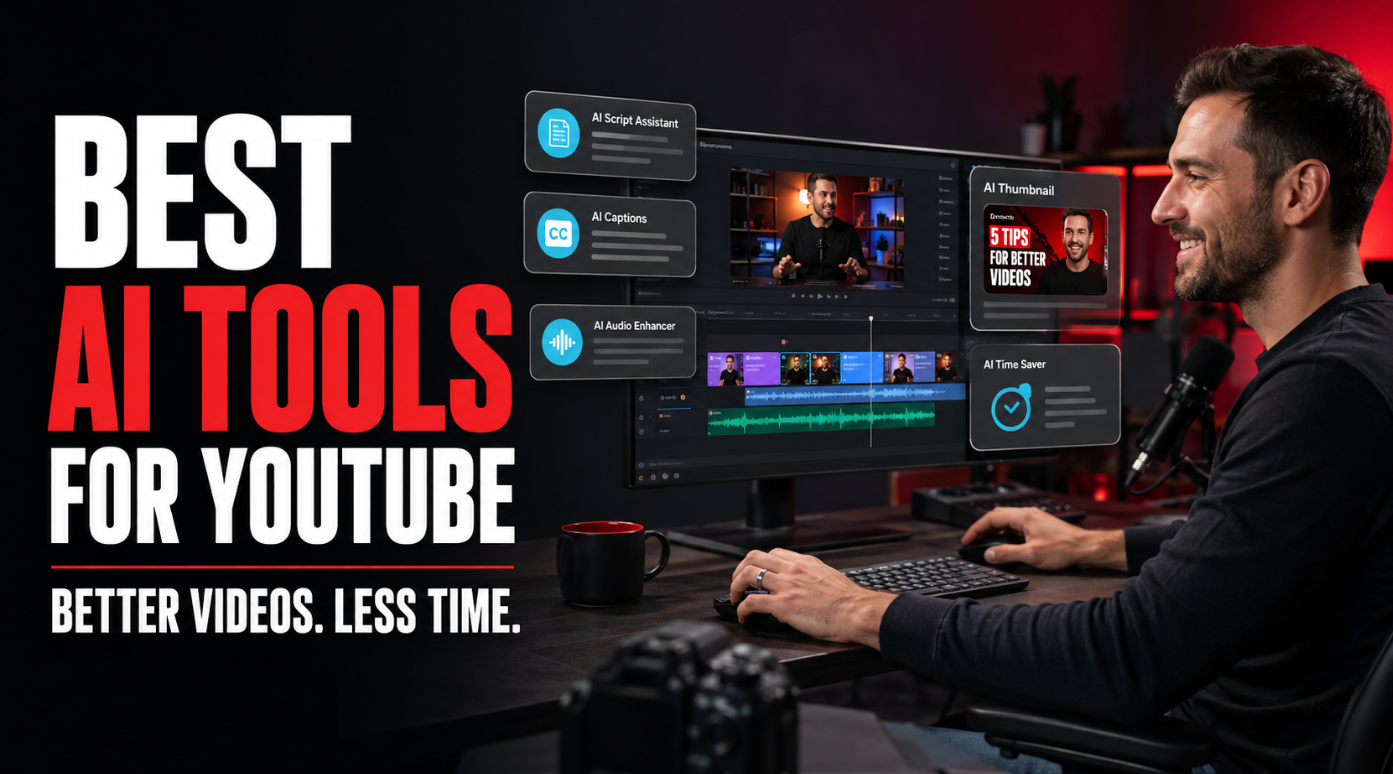
Making a YouTube video involves far more than pressing Record. A creator may research a topic, shape an angle, write a script, organise footage, remove pauses, repair audio, add captions, design a thumbnail, cut Shorts and study the results. Each step can consume an afternoon before viewers see a single frame.
The best AI tools for YouTube creators reduce that production friction. They can turn a transcript into an editable timeline, locate useful moments in a long recording, draft alternative hooks, clean noisy speech and generate thumbnail concepts. However, speed is only valuable when the finished video still contains your judgement, experience and point of view.
The quick verdict is simple: ChatGPT is the most flexible planning assistant, Descript is the easiest editor for spoken videos, CapCut is excellent for fast Shorts, Adobe Premiere Pro and DaVinci Resolve offer deeper professional control, Canva simplifies thumbnails, OpusClip accelerates repurposing, ElevenLabs handles synthetic voice and dubbing, vidIQ supports channel research, and YouTube Create offers a strong mobile-first starting point.
Best starter stack: Use ChatGPT for planning, YouTube Create or CapCut for editing, Canva for thumbnails and YouTube Studio for testing. Add a specialist tool only when the same bottleneck repeatedly costs you time.
This guide compares ten practical options, explains who each one suits and introduces a VIDEO test for choosing tools without wasting money.
| Tool | Best for | Main time-saving job | Important limitation |
|---|---|---|---|
| ChatGPT | Ideas and scripts | Turns source material into outlines, hooks and production plans | Can invent facts or produce generic scripts |
| YouTube Create | Mobile creators | Builds an editable first cut from phone footage | Availability and features can vary by device or region |
| Descript | Talking-head and podcast videos | Edits video by editing its transcript | AI actions and media processing use plan allowances |
| CapCut | Shorts and fast social edits | Automates captions, reframing and template-led edits | Trend-heavy defaults can make channels look alike |
| Adobe Premiere Pro | Professional long-form editing | Finds footage and automates repetitive timeline work | Higher learning curve and subscription cost |
| DaVinci Resolve | Editing, colour and audio control | Uses its Neural Engine for transcription, tracking and reframing | Advanced features require capable hardware and practice |
| Canva | Thumbnails and channel graphics | Produces fast, editable visual concepts | Generated designs still need brand and accuracy checks |
| OpusClip | Repurposing long videos | Finds short-form moments and reframes them | A high-scoring clip may not suit your audience or context |
| ElevenLabs | Voiceover and dubbing | Generates speech and multilingual versions | Consent, pronunciation and commercial rights need checking |
| vidIQ | Ideas and optimisation | Surfaces channel-specific patterns, titles and topic opportunities | Recommendations do not guarantee views |
However, there is no honest one-number winner because these tools solve different problems. For example, a creator filming travel vlogs on a phone needs a different stack from a studio producing hour-long interviews. Therefore, identify the slowest repeated step in your workflow before choosing a product.
This comparison does not rank products by the length of their feature lists. Instead, each tool is judged through the VIDEO test:
| Letter | Test | Question to ask |
| V — Viewer value | The tool helps the audience understand, enjoy or use the video. | Does this change improve the viewer’s experience? |
| I — Identity preserved | Your voice, examples and visual style remain recognisable. | Could this output belong to any channel? |
| D — Drudgery reduced | It removes repetitive labour rather than creative judgement. | Which manual step becomes faster? |
| E — Evidence checkable | Claims, captions, licences and analytics can be verified. | Can I inspect what the AI changed or assumed? |
| O — Output editable | You can correct the result before publishing. | Can I revise the script, cut, voice or image easily? |
The best AI tools for YouTube creators normally perform well on all five tests. However, a generator that makes a complete video in seconds may reduce drudgery, yet fail the identity and evidence checks. Conversely, a transcript editor can save hours while leaving every editorial decision visible.
ChatGPT is the broadest planning tool in this list. It can help a creator turn audience questions into video ideas, compare possible angles, organise research, develop a beat-by-beat outline and produce a first script. It can also convert a finished transcript into chapters, descriptions, pinned-comment options and repurposing notes.
First, the strongest workflow begins with your material. Provide audience comments, previous-video results, interview notes, product documentation or trusted sources. Then state the intended viewer, video length, tone and promise. Official OpenAI prompting guidance recommends specifying the goal, useful context, desired output and boundaries for important tasks.
However, do not ask, “Write a viral YouTube script about productivity.” That request invites familiar clichés and unsupported claims. Instead, give ChatGPT a defensible angle and require it to flag missing evidence. When sources matter, Iziraa’s comparison of the best AI search engines for sources shows why opening and checking citations remains essential.
Copy-ready prompt:
Create a seven-minute YouTube outline for
[audience]about[topic]. The viewer’s problem is[problem], and the video must deliver[specific result]. Use only the attached sources and my experience notes. Start with three hook options that make a clear promise without exaggeration. Build five sections with a visual or demonstration idea for each. Flag every claim that needs verification. Preserve my wording where it expresses a personal opinion, and do not invent experiences or statistics.
Therefore, ChatGPT is especially useful when you already have expertise but need structure. However, it is less trustworthy when asked to become the expert without sources. Iziraa’s guide to ChatGPT mistakes that make good prompts fail explains why polished language must still be fact-checked.
Best for: explainers, tutorials, interviews, educational channels and creators who struggle with blank-page planning.
Watch out for: invented facts, repetitive hooks, excessive list formats and scripts that sound unlike you.
YouTube Create is designed for creators who record and edit on a phone. Its current Edit with AI feature can select moments from raw footage, add music and effects and provide a first draft that the creator can customise. This makes it useful for vlogs, event clips, product demonstrations and fast Shorts.
Moreover, the major advantage is proximity to the platform. Instead of moving footage through several services, a creator can assemble a draft in a YouTube-focused environment. As a result, it can remove the intimidating first step of sorting dozens of mobile clips.
However, “first draft” is the important phrase. An automated edit cannot know which reaction matters to your story, whether an awkward pause builds anticipation or why a small detail is meaningful to your regular audience. Therefore, review the opening, narrative order, music level, captions and ending before export.
YouTube’s official Create with AI guidance describes the AI edit as a customisable starting point rather than a finished editorial decision. Availability may also depend on region, account, language and device, so check what appears in your app before building a production plan around it.
Best for: beginners, phone-first vloggers, local-business creators and rapid Shorts production.
Watch out for: accepting the automatic clip order, mismatched music and assuming every feature is available everywhere.
Descript changes the mental model of editing. It transcribes a recording and lets you cut video by editing words in the transcript. For a creator who produces interviews, lessons, commentary or video podcasts, deleting a sentence can feel more natural than moving clips on a traditional timeline.
Its AI tools can clean speech, remove filler words, create clips, improve audio and help produce publishing notes. Underlord, Descript’s AI co-editor, can perform editing actions from plain-language requests. The official Descript AI tools overview groups these capabilities around writing, editing, improving and repurposing content.
As a result, this can remove hours of rough-cut work. Nevertheless, filler removal needs judgement. For example, every “um” is not a mistake; natural speech has rhythm. Removing all pauses can make a thoughtful speaker sound rushed and can create visible jump cuts.
Useful instruction:
Create a rough cut that removes false starts, repeated sentences and pauses longer than
[duration]. Keep brief thinking pauses and natural reactions. Do not change the order of ideas. Mark every cut for review, and leave the original composition unchanged.
Therefore, Descript is one of the best AI tools for YouTube creators whose main footage is speech. However, it is less essential for cinematic montages, complex colour work or effects-heavy productions.
Best for: podcasts, interviews, courses, commentary and screen-recorded tutorials.
Watch out for: over-cleaning speech, transcription errors in names and technical terms, and using AI credits on avoidable experiments.
CapCut combines a familiar timeline with templates and AI features such as automatic captions, background removal, text-to-speech, reframing and script-to-video generation. It is particularly attractive to creators who need vertical videos quickly and want strong caption styling without building every animation manually.
Its official auto-caption tool converts speech into synchronised, editable text and supports multiple languages. That can save substantial typing time, especially for Shorts watched without sound.
Yet captions are not “finished” because they look attractive. Therefore, review names, numbers, Kiswahili words, technical terms and punctuation. Also keep captions inside mobile-safe areas, limit each on-screen phrase and use enough contrast to remain readable over changing footage.
Meanwhile, CapCut’s templates are both a strength and a weakness. They speed up editing, but popular transitions, fonts and sound patterns can make unrelated channels feel identical. Therefore, use a limited brand palette, consistent caption style and your own footage wherever possible.
For creators handling several social platforms, Iziraa’s guide to AI tools for social media managers provides a wider repurposing context.
Best for: Shorts, fast explainers, mobile creators, caption-heavy clips and social-first teams.
Watch out for: template sameness, uncorrected captions, over-editing and uncertain rights for third-party music or assets.
Premiere Pro remains a professional editing environment first; its AI features support that environment instead of replacing it. Media Intelligence can search visuals, transcripts and metadata across a large project, helping an editor find “the wide shot where the speaker points to the chart” without opening every clip. Translate Captions accelerates multilingual subtitle work, while Generative Extend can add a small amount of video or ambient audio to smooth timing.
Adobe’s official Media Intelligence guidance explains that creators can search footage using visual descriptions, spoken words and embedded metadata. For documentary, event and commercial editors with hundreds of clips, that search function may save more time than flashy content generation.
Generative Extend is useful for covering a transition or holding a reaction slightly longer, but it has limits. Adobe states that it does not extend spoken dialogue and does not accept clips containing music for extension. An editor should also review generated frames for strange motion or changed details.
Therefore, Premiere is a sensible choice when the creator already values detailed timelines, proxies, multi-camera work, colour integration and professional delivery. However, it may be excessive for someone publishing two simple Shorts each week.
Best for: agencies, documentary channels, branded content, multi-camera productions and advanced long-form videos.
Watch out for: cost, hardware demands, a steeper learning curve and treating generated frames as factual footage.
In addition, DaVinci Resolve combines editing, colour grading, visual effects and audio work. Its AI Neural Engine supports time-consuming tasks such as object detection, smart reframing, tracking, transcription, facial organisation and speed processing. Therefore, this makes Resolve appealing to creators who want one deep production application and are willing to learn it.
Blackmagic Design’s official DaVinci Resolve overview positions the Neural Engine as a way to solve repetitive production problems while keeping the creator inside a full professional editor. Some AI features belong to the paid Studio edition, so check the current feature table rather than assuming every demonstration applies to the free version.
In particular, Resolve is strong when “better video” means controlled colour, cleaner audio and careful finishing rather than instant generation. AI can help track a subject or reframe a shot, but the creator still decides whether the grade serves the story and whether the crop hides important context.
Best for: creators progressing towards professional editing, cinematic channels, colour-critical projects and people who prefer a capable free editor before paying.
Watch out for: demanding hardware, feature differences between free and Studio versions, and the time required to learn advanced pages.
Canva makes it easy to produce editable thumbnail concepts, banners, end-screen graphics and community posts. Magic Media can generate images or short video assets from prompts, while templates provide quick starting points for layout and typography.
For example, AI is most useful during thumbnail ideation. Generate several compositions, then replace inaccurate faces, products or interface elements with real assets. Finally, keep the message simple: one clear subject, a strong contrast, readable text and a visual question that the video genuinely answers.
However, do not rely on aesthetic instinct alone. YouTube Studio now lets eligible creators A/B test up to three titles and thumbnails, selecting the option that produces the highest watch-time share. Therefore, that native evidence is more valuable than an AI tool’s predicted “click score”.
AI-generated thumbnails can also mislead. If the image promises an event, result or product that never appears in the video, clicks may rise briefly while retention and trust fall. YouTube’s own guidance warns that clickbait can produce high click-through rates but weak average view duration.
Best for: solo creators, non-designers, educators, small businesses and teams that need consistent branded graphics.
Watch out for: tiny text, generic templates, fabricated visual claims and assuming a beautiful thumbnail will fix a weak topic.
OpusClip is built for one repeated job: finding short-form moments inside long recordings. It can analyse visual, audio and sentiment cues, reframe footage vertically, add captions and prepare clips for social platforms. This is useful when a creator records webinars, interviews, podcasts or long explainers but lacks time to watch the entire video again for highlight moments.
The official OpusClip introduction describes text- and timeline-based editing, captions, filler removal, reframing and publishing support. Its ClipAnything feature also lets users prompt for a particular scene or moment rather than relying only on automatic selections.
Therefore, treat generated clips as candidates. For example, a dramatic 25-second statement may depend on the sentence before it. A clip may score well because it contains emotion but misrepresent the speaker when separated from the full discussion. Finally, review the first two seconds, contextual accuracy, caption text, crop and ending before scheduling.
Best for: podcasters, interview channels, webinar hosts and creators with an existing long-form library.
Watch out for: context loss, awkward facial reframing, excessive captions and posting too many similar clips.
ElevenLabs can generate text-to-speech narration and help dub content into other languages. It is valuable when a creator cannot record clean audio, needs an accessibility version or wants to test whether another language can reach a new audience.
However, the technology does not remove editorial responsibility. For example, a natural voice may still pronounce Tanzanian names, technical language, currencies or abbreviations incorrectly. Therefore, listen to the complete output with headphones, correct pronunciations and ensure the emotional delivery fits the scene.
Moreover, rights matter. ElevenLabs states that commercial rights depend on the plan and service used; its commercial-use guidance says paid-plan output can generally be used commercially when the user holds the necessary intellectual-property rights and complies with applicable terms. However, beta services may have different restrictions. Therefore, current terms should be checked before publication.
Never clone another person’s voice without clear permission. If a realistic synthetic voice or other meaningful AI alteration could mislead viewers, follow YouTube’s disclosure requirements.
Best for: faceless explainers with original scripts, accessibility, multilingual tests and creators improving weak recording conditions.
Watch out for: voice-consent issues, wrong pronunciation, emotional mismatch, plan-specific rights and synthetic delivery that reduces trust.
vidIQ focuses on YouTube rather than general writing. Its tools can surface topic opportunities, competitor patterns, titles, thumbnails and channel-level questions. AI Coach can analyse a video or channel context, while trend and outlier tools help creators investigate what is attracting attention in a niche.
As a result, that context can be more useful than asking a general chatbot for “viral ideas”. However, the tool sees patterns, not your future. For example, a rising keyword may be irrelevant to your audience, beyond your expertise or impossible to cover with original evidence.
The current vidIQ Scorecard documentation describes prompts for analysing hooks, performance and related ideas. Use those suggestions to form hypotheses, then verify them with YouTube Studio data: impressions, click-through rate, audience retention, returning viewers and traffic sources.
Creators should also remember that YouTube is a recommendation platform, not merely a keyword engine. A perfectly optimised title cannot rescue a video that loses viewers during its opening minute.
Best for: creators who need structured topic research, competitor observation and channel-aware prompts.
Watch out for: chasing trends outside your niche, treating scores as guarantees and copying competitors instead of learning from patterns.
Choose according to the bottleneck, not the loudest marketing claim.
| Your main problem | Start with | Add later if needed |
| “I cannot turn ideas into scripts.” | ChatGPT | vidIQ for channel-specific research |
| “Editing spoken videos takes too long.” | Descript | Premiere Pro for advanced finishing |
| “I create mainly on my phone.” | YouTube Create | CapCut for more social templates |
| “I need polished professional control.” | DaVinci Resolve or Premiere Pro | Specialist audio or graphics tools |
| “My thumbnails look inconsistent.” | Canva | YouTube Studio A/B testing |
| “I have long videos but no Shorts.” | OpusClip | CapCut for manual polishing |
| “My narration quality is weak.” | Improve recording first; then ElevenLabs | Professional voice talent when appropriate |
| “I do not know what to publish next.” | YouTube Studio analytics | vidIQ, then ChatGPT for development |
Therefore, the cheapest sensible workflow uses tools already available before adding subscriptions. First, YouTube Studio provides audience data and testing. In addition, YouTube Create or DaVinci Resolve can cover much of the editing process. Canva and several other products have free tiers, although limits and licensing can change. This is another reason the best AI tools for YouTube creators should be chosen by workflow rather than hype.
For a wider view of low-cost digital work tools, see Iziraa’s guide to practical AI tools for small businesses. In addition, creators building a repeatable assistant-led workflow can learn from AI tools for virtual assistants.
First, review YouTube Studio, audience comments, search queries, frequently asked questions and previous retention graphs. Then write one sentence describing the viewer, problem and promised result.
Second, use ChatGPT or vidIQ to generate options, but select an angle supported by your experience and evidence. Moreover, ask what is missing from competing videos rather than copying their structure.
Next, draft in short sections. Then read every paragraph aloud. Replace abstract language with demonstrations, examples and visuals. Iziraa’s guide to making ChatGPT sound more human offers useful editing checks for removing generic AI phrasing. Its companion collection of ChatGPT prompts for SEO writers also shows how useful constraints can preserve originality across content formats.
Then, capture your screen, face, environment, experiment, interview or demonstration. As a result, original evidence gives viewers a reason to choose your video over a mass-produced summary.
Afterwards, let Descript, YouTube Create, CapCut, Premiere Pro or Resolve handle transcription, search, silence detection or first-pass arrangement. However, preserve the original files and keep cuts reviewable.
Next, create three genuinely different thumbnail concepts. Use Canva for layout and OpusClip for Short candidates. Then verify that each title, thumbnail and clip accurately represents the main video.
Finally, use YouTube Studio to test thumbnails or titles where available. Review retention dips, traffic sources, comments and returning-viewer behaviour. Then feed observations—not merely view counts—into the next production cycle.
Analyse these audience comments and previous-video notes:
[paste]. Group the repeated problems, questions and misconceptions. Suggest five video angles I can support with my listed experience or sources. For each, state the viewer, promise, required evidence and what would make the video different from a generic summary. Do not predict virality.
Review this opening:
[paste]. Identify the promise, delay, unnecessary background and unanswered question. Write three revised openings under 75 words: direct, story-led and demonstration-led. Each must accurately match the video’s real content and avoid exaggerated claims.
Turn this approved script into an editing map with columns for narration, A-roll, B-roll, on-screen text, source or evidence, sound and approximate duration. Use visuals to clarify ideas rather than decorate every sentence. Flag any asset that may require a licence.
Propose five thumbnail concepts for this video:
[summary]. Use one focal subject, no more than four words of optional text and strong mobile contrast. Explain the curiosity gap and prove that each concept is supported by something viewers will actually see in the video. Do not fabricate reactions, results or product features.
Audit this transcript, title, description and thumbnail description as one YouTube package. Check promise-to-content alignment, unsupported factual claims, missing source credits, likely caption errors, confusing sections, copyright or disclosure questions and repeated AI phrasing. Prioritise the five fixes most likely to improve clarity and trust.
Most importantly, AI should not impersonate expertise you do not have, clone voices without permission, fabricate testimonials, invent product results or generate realistic events that viewers could mistake for reality. In addition, it should not copy another creator’s script, thumbnail or signature presentation style.
YouTube’s current channel monetisation policy says mass-produced or repetitive “inauthentic content” is not eligible for monetisation. The policy does not prohibit useful AI assistance; the problem is content that appears templated, minimally varied or produced at scale without meaningful original value.
YouTube also requires creators to disclose realistic content that is meaningfully altered or generated with AI. Its synthetic-content guidance explains that disclosure is made during upload. Minor production assistance—such as script ideation, caption generation or colour correction—does not automatically require the same label, but realistic synthetic scenes, voices or events can.
Before publishing, complete five checks:
Privacy matters too. Do not upload unpublished sponsor materials, private customer information, children’s data, passwords or confidential interview footage to a tool without understanding its controls and your obligations. Iziraa’s ChatGPT privacy guide provides a useful starting framework even when the final tool is not ChatGPT.
Therefore, a subscription is justified when it saves more valuable time than it costs and the output passes review. First, measure one real workflow before paying annually.
For example, record the time required to caption, rough-cut and repurpose one typical video manually. Then test the tool on the same kind of footage. In addition, include correction time, export time, credit limits and the cost of fixing errors. A feature that promises a ten-minute edit but needs forty minutes of repair has not saved an hour.
Also inspect usage allowances. For example, some products charge by processing minutes, AI credits, generated seconds or exports. Moreover, unused monthly credits may expire. Prices and plan names change, so this article intentionally avoids presenting temporary prices as permanent facts.
The best buying sequence is conservative:
The best AI tools for YouTube creators do not replace the creator. They remove blank-page delays, transcription, footage searching, repetitive reframing, caption typing and first-pass design work. The valuable decisions—what is true, what matters, what the viewer needs and what your channel stands for—remain human.
For most beginners, the strongest starting combination is ChatGPT + YouTube Create or CapCut + Canva + YouTube Studio. Spoken-content creators gain more from Descript. Professional long-form editors should compare Premiere Pro and DaVinci Resolve. OpusClip becomes valuable when a long-form library needs Shorts, ElevenLabs when voice or language is a genuine bottleneck, and vidIQ when channel-specific research is weak.
Therefore, choose the smallest stack that fixes your slowest step. Then measure whether it improves viewer value, preserves your identity, reduces drudgery, exposes evidence and keeps every important output editable. Ultimately, that is how the best AI tools for YouTube creators produce better videos in less time without turning a channel into generic automated content.
There is no single winner, but a beginner can start with ChatGPT for planning, YouTube Create or CapCut for editing, Canva for thumbnails and YouTube Studio for analytics and testing. This covers the main workflow before paid specialist tools become necessary.
Yes, several tools can generate scripts, visuals, voices, captions and edits. However, fully generated output still needs factual, licensing, disclosure, quality and originality checks. A complete automated video is not automatically a useful or monetisable one.
Descript is often easiest for spoken videos because editing the transcript edits the timeline. YouTube Create and CapCut are approachable for mobile and short-form work. The easiest option depends on the footage and the amount of control required.
CapCut is generally stronger for quick vertical videos, visual effects and styled captions. Descript is generally stronger for interviews, podcasts, commentary and other speech-led videos. Creators should test both using one typical project.
AI assistance does not automatically prevent monetisation. Nevertheless, YouTube requires original, authentic value and may reject repetitive or mass-produced content. Creators must also follow copyright, disclosure, advertiser and community rules.
YouTube requires disclosure when content is meaningfully altered or generated with AI and appears realistic. Minor assistance such as idea generation, captioning or ordinary production edits does not necessarily require the same disclosure. Always check the current upload guidance for the specific content.
They can shorten production and improve consistency, but no tool guarantees views or subscribers. Topic relevance, viewer satisfaction, originality, packaging and learning from analytics matter more than the number of AI features used.